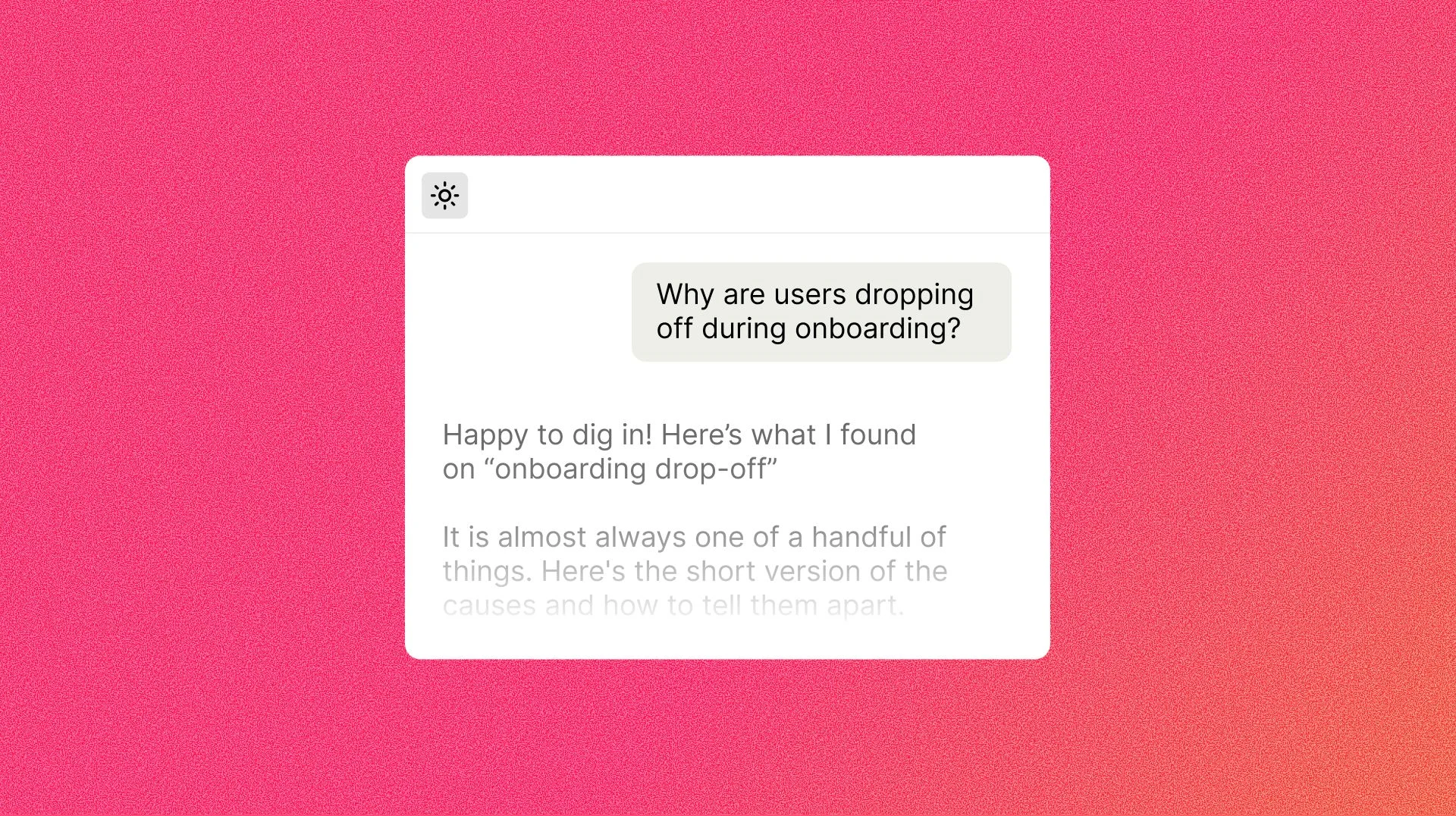
The best AI agents already work from more than a knowledge base. Fin draws on account data, connected systems and product usage to resolve problems and reach out to customers proactively.
But some of the richest signals about where users struggle live in the product itself: where they get frustrated, where they drop off, where they keep hitting a paywall. That’s the behavioral layer Pendo captures.
Pendo Agent Toolkit brings that layer to Fin. Pendo detects friction in the product and sends a webhook to Fin with page context attached, so Fin can start the conversation before a ticket exists. Fin can also pull what the user was doing over MCP, so it answers the specific problem instead of asking clarifying questions. Here's what that looks like in production.
What changes when your agent sees what users do
Users are notoriously bad at articulating the real problem. When they say, "this feature doesn't work," what they mean is: "I've tried to complete this workflow five times, I don't understand the UI, and I'm about to give up and cancel."
Behavioral data within a product tells you the second thing. Pendo captures that data: frustration signals, workflow completions, feature adoption rates, NPS, sentiment, and predictive churn scores built on actual usage patterns. With Agent Toolkit, that intelligence goes straight to the agent, so it can act on those signals in real time, alongside the user and conversation context it already uses.
What this looks like in practice
A user is stuck before they know they're stuck. Pendo data showed Teachable that a third of new-user support conversations started on the Course Pricing page. With Pendo connected, Teachable’s Fin agent, Sunny, started reaching out at the moment of friction, before users asked for help. Six weeks in, 67% of Pendo-initiated conversations were resolved, vs. 54% for Teachable's automation overall, and 91% never needed a human. Read the full Teachable story.

The same Pendo signals that trigger support conversations can drive retention and expansion. Teachable's next trigger fires when a creator starts Stripe onboarding and drops off. Two more examples of what teams can build:
- Catch an at-risk account early. Say usage on a key account drops 35% over three weeks and nobody has said a word. A CSM might spot it in a monthly review. With Pendo signals feeding the agent, Fin can start a personalized re-engagement the week it happens: a check-in, a reminder of features they haven't tried, or an offer to book time with the team.
- Start the upgrade conversation at the right moment. Picture a user who has exported 47 files against a plan limit of 50 and has spent two weeks exploring features behind a paywall. Fin can open a timely, low-pressure conversation about the next tier, instead of relying on a broad email blast.

We tested it on ourselves
Pendo's own support team uses Fin as the first line of support, so its answers shape both customer experience and ticket volume. But without product context, customers had to explain where they were and what went wrong before Fin could give a specific answer. Break/fix questions, which depend most on that context, were the hardest to resolve without a human.
The team connected Agent Toolkit to Fin through Pendo MCP. Now, Fin sees what the customer was doing when they asked: the page they were on, the errors they hit, and the steps that led there. It skips the clarifying questions and answers the specific problem.
Within two months:
- Break/fix resolution rose from about 51% to about 59%
- How-to resolution rose from about 93% to about 98%
- CSAT on Fin conversations rose from about 77% to about 87%
Teachable uses Pendo to start the conversation. Our support team uses it to make the conversation better once it starts.
Who this is for
Agent Toolkit is for the people who own the agent, including:
- Support and CX leaders running Fin who want higher resolution as volume grows. Proactive, contextual support before the ticket is the highest-leverage place to start.
- AI product and support ops teams who are accountable for how the agent performs. Product context gives the agent a warm start, and Agent Analytics shows whether it's working.
- Product and growth teams who already know where users struggle because Pendo shows them, and now have a direct line to act in the moment.
The integration with Fin is available today. Running a different support agent? Agent Toolkit connects to any MCP-ready agent you’re building, so reach out to your account manager to set it up.
Getting started
Setup takes 30 to 60 minutes, and Pendo admins can turn it on with the setup wizard. Teachable had it running in about an hour. To try it, fill out the form or reach out to your account manager.
Once it's live, Pendo Agent Analytics shows whether those conversations are driving outcomes, so you can prove the value.
The Pendo × Fin integration is part of Pendo for Agents. Agent Toolkit, built on Pendo MCP, gives your agents product context, and Agent Analytics measures what they deliver.