Table of Contents
What is user analytics?
User analytics is a way of analyzing user data in order to give companies a clearer view of user cohorts. Typically, a business intelligence software is used to combine customer behavior data from web and mobile applications to create a holistic view of the user and the user experience.
Product managers, customer success managers, and digital marketers can use this data—even combining it with customer surveys and feedback—to better segment their customer base and take steps to engage the right groups of users with the most relevant experiences to more efficiently drive business growth and customer retention.
There are two common ways a product manager, customer success manager, or digital marketer can view user analytics data to start making decisions and taking action:
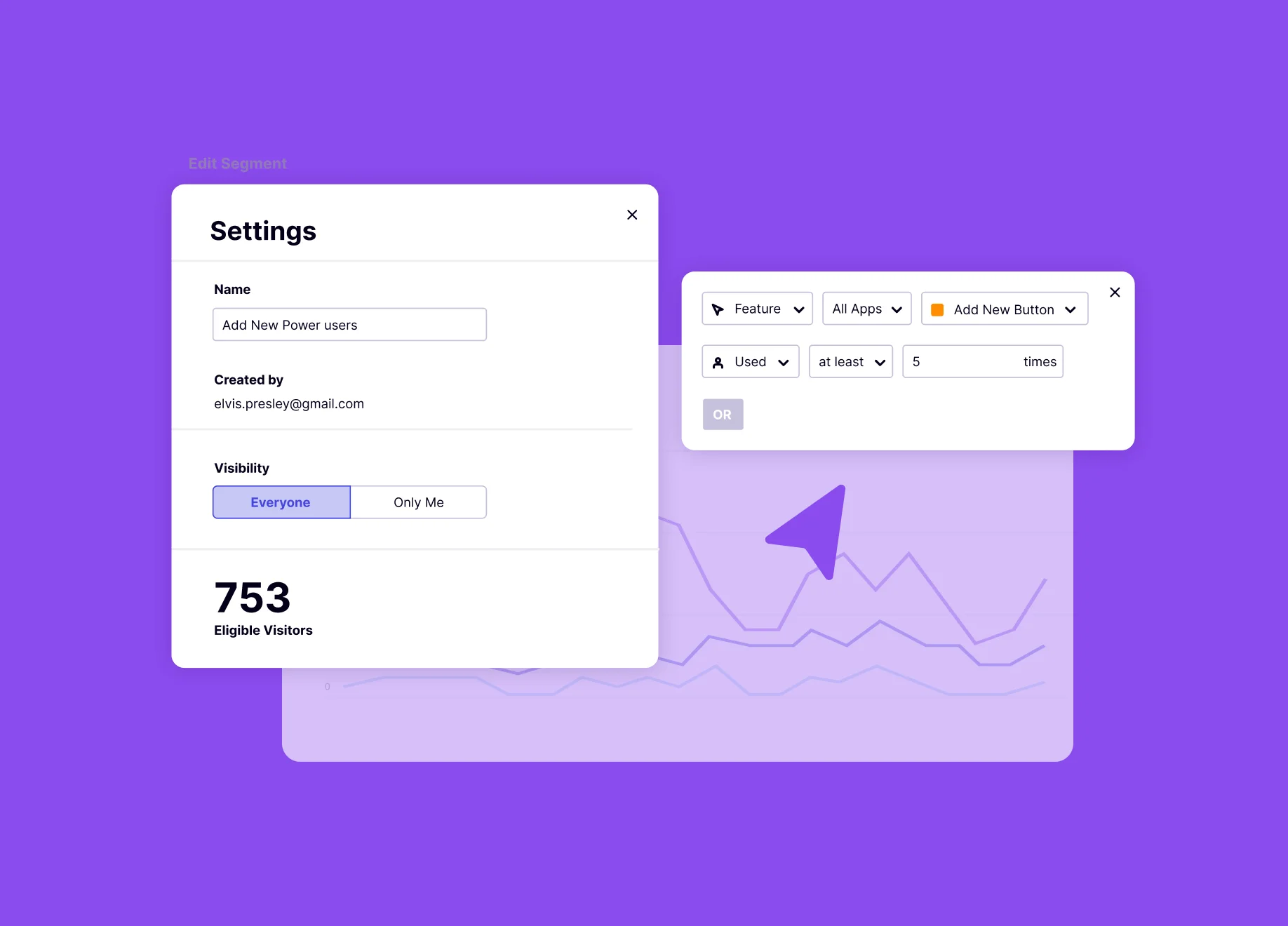
- Segments: Within a product analytics view that groups usage data into trends, funnels, and paths, segmenting the input data by user or account characteristics provides a more actionable set of insights than by features and pages alone. Segments can be defined by user, usage events, survey data, as well as external sources, like referral channel or data from marketing and sales management systems.
- Retention: By grouping user and usage data, companies can understand which cohorts find the product to be sticky—and which don’t. Retention funnels usually look at historical return rates among a specific group of users by a chosen duration of time, like hours, days, weeks, months, or years.
What’s the value of user analytics?
The value of user analytics falls into two large categories: business insights and taking action. Let’s have a look at each:
- Business Insights
User analytics have advanced the way companies understand and segment their customer base. By enabling product teams to create dashboards that group and filter product interaction data by both behavioral cohort and profile attributes, user analytics tools provide the connective tissue between the customer experience and key business metrics like customer acquisition cost (CAC), net revenue retention (NRR), and lifetime value (LTV). - Taking Action
User analytics drawn from web and mobile app interactions also provide an opportunity to further engage with user cohorts. Notifications, tutorials, offers, and guides are all methods that product managers, customer success managers, and digital marketers can use to target, influence, and promote behavior change or new behaviors among specific segments of the customer base directly within the product. These are all faster and more customized—and, in many cases, more effective—approaches to steering user activity than changing the product altogether.
What are the use cases for user analytics?
User analytics help companies understand and guide groups of customers to successful outcomes. Segmenting the customer base from user behaviors is an effective way to answer important questions that can drive business results:
- What behaviors are early signals of likelihood to churn?
- Which profile characteristics contribute to feature retention?
- Why does a feature variation cause users to behave differently?
- How does customer vertical, device type, or referral channel affect outcomes?
- When did the most valuable cohorts become users?
As an example, Labcorp used analytics in Pendo to find that users were dropping out of the new user registration process on its patient portal for two reasons: Adding an extra space at the end of a name created an error message, and a third-party authentication tool was taking too long to load. The team shared that information with their development teams and the third-party partner to resolve the issues and support tickets dropped by 99%.
How did user analytics evolve?
In the past, companies had two basic ways of dividing whatever market they served. Broad-stroke demographic/firmographic data that provided a general picture of the target buyer, and surveys, which are susceptible to any number of biases.
In contrast, user analytics provide quantitative data to build user cohorts that are based on a combination of digital behaviors, context, and user profile data. For each user, the analytics database is populated with a stream of actions plus properties including date and time, location, device and system type, specific user and query inputs, referral channel, and much more. For users who have been identified, the database also includes all known demographic and firmographic data. The behavior data is immutable, while the profile data can be changed and updated over time.
From this data, user analytics enable cohorts to be derived from specific user behaviors or the combination of behaviors, profile details, context properties, or the intersection of multiple of these over a specified period of time. Behavior-based segmentation is not only more flexible, since cohorts can be as small as a single user or as large as the entire population, but also more relevant, since the actions on which the cohorts are based have already been observed, not presumed.
Where can I learn more about user analytics?
For those looking to dig a little deeper into user analytics, there are a number of books on the subject, including “Lean Analytics” by Alistair Croll and Benjamin Yoskovitz. Coursera also offers online courses on user acquisition vs. retention and customer and user analytics. Pendo has also published content for those looking to take action on user insights, reduce customer churn, and drive account expansion.