AI agents are changing how people use software. They can answer questions, summarize information, recommend next steps, trigger workflows, and help teams move faster across the tools they already use.
But an agent is only as useful as the context it can access.
For software companies, that context cannot stop at documentation, help articles, or static product data. Agents also need to understand what users are doing, where they are getting stuck, what they are trying to accomplish, which accounts are affected, and what outcomes matter to the business.
That is product context.
How is product context defined?
Product context is the connected understanding of how people and agents interact with your software. It brings together behavior, feedback, workflows, sentiment, account signals, feature usage, and outcomes so teams can see what is happening inside the product and act on it with confidence.
Without product context, AI agents may sound useful, but they are often working from an incomplete picture. With product context, they can become grounded in the real experience of your users.
AI agents need to be grounded in what’s happening in your product.
Much of the conversation around AI has focused on better prompts. Better prompting helps, but prompts alone cannot tell an agent what is happening inside your product.
An onboarding agent needs to know where new users drop off. A support agent needs to know whether a user has already tried a workflow and failed. A product agent needs to know which features are adopted, which are ignored, and which are creating friction. A revenue agent needs to know whether usage patterns signal expansion, risk, or confusion.
That context does not live inside the prompt. It lives in the product.
This is where product context becomes essential. It gives agents access to the same signals strong product teams already use to make decisions: product analytics, user journeys, feedback, sentiment, account behavior, and real usage patterns.
The goal is not simply to make agents more informed. The goal is to make them useful in the moments where product experience and business outcomes meet.
What product context includes
Product context is not a single metric or dashboard. It is a connected layer of signals that explains what is happening, who it affects, and what should happen next.
It starts with behavior. Which users are active? Which features are they using? Which workflows do they complete? Where do they abandon the experience?
It includes friction. Where are users hesitating, repeating actions, rage clicking, or asking for help? When teams can pair analytics with session replay, they can move from "something is wrong" to "this is what the user experienced."
It includes voice of customer. Feedback, sentiment, NPS, support conversations, and user requests help explain what users need in their own words. Tools like Pendo Listen help connect what users say with what they actually do.
It includes business context. Product behavior means more when it is connected to accounts, segments, retention, expansion, support costs, and revenue impact.
And increasingly, it includes agent behavior. As more companies add AI agents to their products and internal workflows, teams need to understand how those agents are being used, which prompts work, where conversations break down, and whether agents are helping users complete tasks.
That is why product context now has to account for both humans and agents.
Product context is the missing layer in context engineering
Context engineering is the practice of giving AI systems the right information, tools, memory, and instructions at the right time so they can perform a task well.
For software companies, product context is one of the most valuable forms of context engineering.
The distinction matters. Context engineering is the method. Product context is the product-specific substance that makes the method useful. A team can build elegant prompts, retrieval systems, and agent workflows, but if those systems do not understand real product usage, they are still missing the signal that matters most.
Product context helps close that gap.
It tells an agent who the user is, what they have done, where they are in the product, what they are likely trying to do next, and whether similar users have succeeded or struggled. It helps the agent move beyond generic advice and toward product-aware action.
This is also why Pendo MCP matters. MCP gives AI tools and agents a secure way to access product usage data, customer context, feature data, visitor activity, account metadata, and engagement patterns. Instead of making teams manually build reports before an agent can help, MCP makes product context available where people already work.
Why agents you build and buy both need product context
Some agents are built directly into products. Others are purchased and used across teams. Some support customers. Some help employees. Some assist product managers, support teams, sales teams, or executives.
All of them need context.
An agent embedded in your product needs to understand what the user is doing in that moment. An internal agent needs to understand the business and product data behind the question it is answering. A third-party assistant needs enough context to avoid giving generic recommendations when the better answer depends on actual user behavior.
This is the idea behind Pendo for Agents: product data should feed the agents companies build or buy so those agents can understand who the user is, what they have done, and what they need next.
It is also where Agent Toolkit extends the story from insight to action. Product context can help an agent surface relevant guides, use session context, accept feedback, nudge users back to important workflows, or respond when behavioral signals show frustration. That is the difference between an agent that waits for a prompt and an agent that can help at the right product moment.
When agents have product context, they can support onboarding, drive adoption, surface expansion opportunities, identify drop-off, and help teams act before small experience gaps become larger business problems.
When agents do not have product context, they are more likely to create generic output, miss user intent, or recommend actions that sound right but do not match what is actually happening.
Product context turns agent activity into measurable outcomes
Shipping an AI agent is not the same as knowing whether it works.
Teams need to know whether people are using the agent, what they are asking, where conversations succeed, where prompts fail, which requests are unsupported, and whether the agent is improving outcomes like task completion, retention, support efficiency, or adoption.
That is where Agent Analytics becomes a critical part of the product context story.
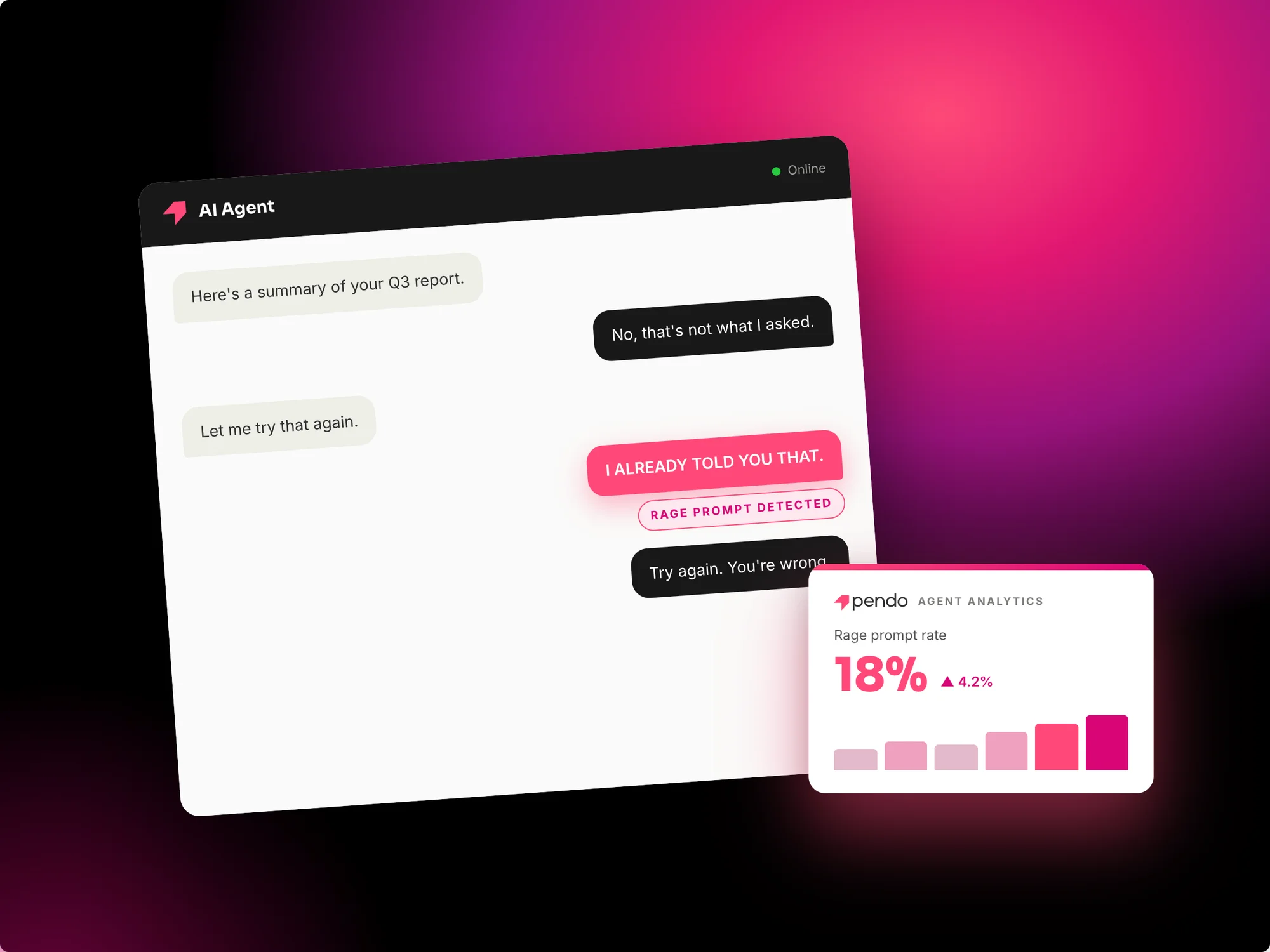
Agent Analytics helps teams analyze conversations and prompts, identify user friction, monitor account-level adoption, understand AI usage, and see where agents break down. It connects agent behavior to the broader product experience, so teams are not looking at agent performance in isolation.
This is an important shift. Traditional product analytics showed how people used software. Product context now has to show how people and agents work across software together.
If an agent speeds up a workflow, product teams should be able to prove it. If an agent creates frustration, they should be able to see where it happened. If an agent is used heavily by one segment and ignored by another, they should know that too.
AI cannot be a black box inside the product experience. Product context makes agent performance visible.
Product context helps teams close the loop
The value of product context is not just understanding. It is action.
When teams can see where users and agents struggle, they can decide what to fix, guide, automate, or optimize. They can use behavioral data to improve onboarding. They can use feedback to prioritize roadmap decisions. They can use replay to understand friction. They can use agent analytics to refine prompts, improve responses, and catch unsupported requests.
That turns product context into a continuous loop:
Plan from evidence. Build the right fix. Observe what happens. Optimize based on outcomes.
This loop is central to how Pendo's product story has evolved. Pendo has always helped teams understand how people use software. Now, as AI agents become part of that experience, Pendo helps teams understand how agents behave too.
The product experience is no longer just human clicks through screens. It is users, agents, workflows, prompts, feedback, and outcomes moving together.
Product context is what makes that system understandable.
How Pendo helps companies build product context
Pendo helps companies capture product context across users, agents, and applications, then turn that context into action. Dont forget even product teams need product context to succeed!
With product analytics, teams can understand what users actually do. With Pendo Listen, they can connect feedback and sentiment to product decisions. With session replay, they can see the moments where users struggle. With in-app guides, they can respond directly inside the product experience. With Pendo MCP, they can make product context available to AI tools and agents. With Agent Toolkit, they can equip agents to guide, support, and act in response to product signals. And with Agent Analytics, they can measure agent usage, prompt performance, adoption, and impact.
Together, these capabilities create a more complete picture of the product experience. Not just what users clicked. Not just what agents said. Not just what customers requested. The full context of what is happening and what teams can do about it.
That is what AI agents need to perform better.
And it is what software teams need to build products people genuinely love to use.