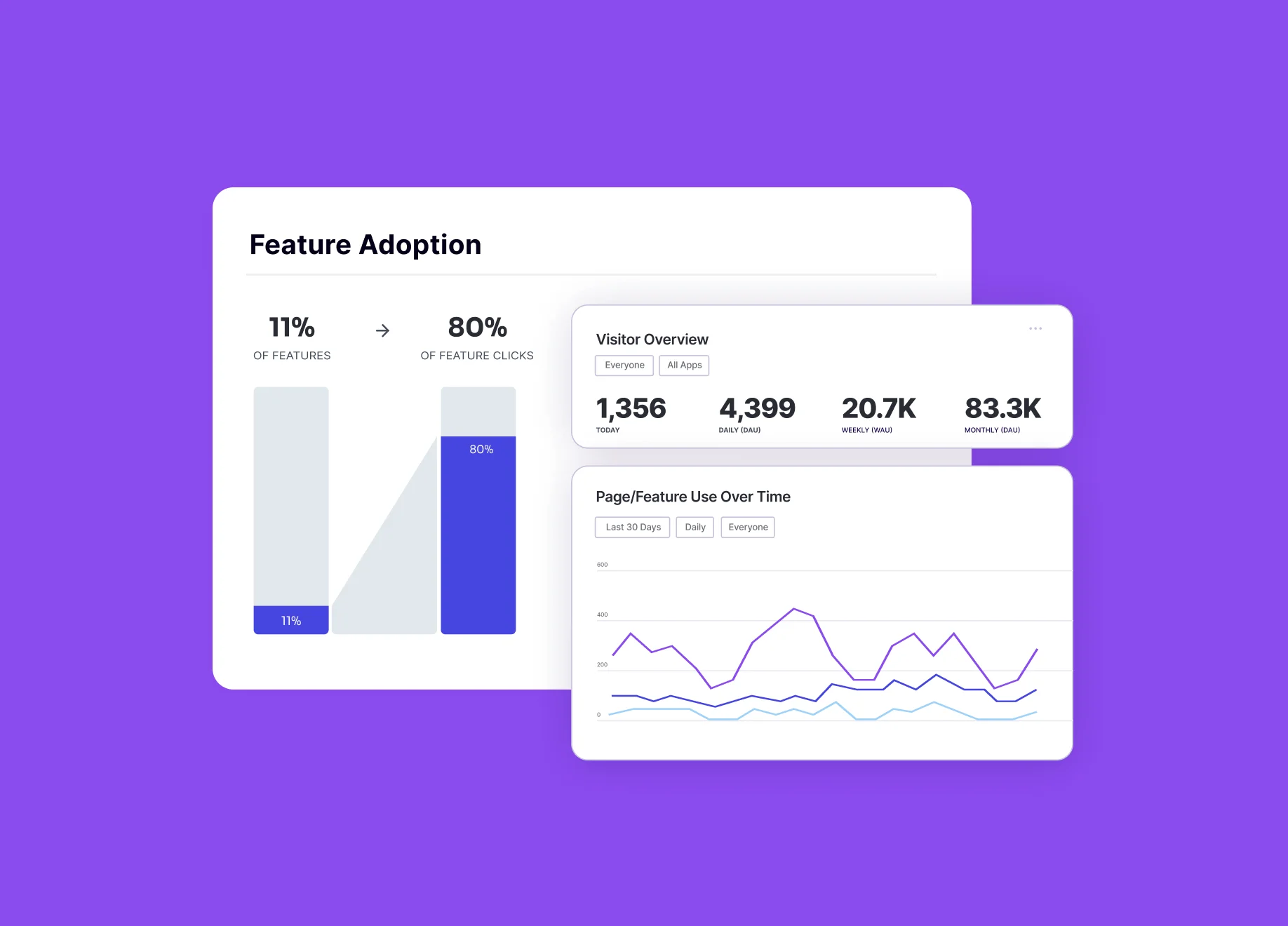
Table of Contents
What is feature adoption?
Put simply, feature adoption measures the usage for a software product’s specific features. The more features a user adopts, the more value they receive, and the less likely they are to abandon the product, making feature adoption a key metric for retention and expansion.
How can feature adoption rate be measured?
Like product adoption, this is a user activation metric. Feature adoption is measured by interaction with a specific feature, rather than login. Typically expressed the same way as product adoption—MAU, adoption rate—with similar considerations for stickiness in defining activation.
Feature adoption rate is measured relative to logins:
Monthly Feature Adoption Rate (%) = [feature MAU / monthly logins] * 100.
Why does feature adoption matter?
With the shift to subscription-based software licensing, software is no longer just purchased once–it’s purchased over and over again as customers renew their subscriptions, sometimes as frequently as every month. This makes it crucial for users to recognize the value of your product as quickly as possible, and continue receiving value on an ongoing basis. Each new feature represents an opportunity to add more value to your users’ experience–but only if they are aware of these features and understand how to make the most of them.
On the flip side, every feature that isn’t being used represents something a customer is paying for, but not getting value from. This lowers a customer’s perceived value and, ultimately, impacts their willingness to renew at the current service/price level, or even renew at all.
Each new feature presents an opportunity for added value. Unused features, however, can have a converse effect. This is why customer success managers are often laser-focused on feature adoption, since key metrics like retention and expansion are contingent on minimizing time to value. Paying for unused features lowers a customer’s perceived value and, ultimately, affects their willingness to renew at current price level, or even renew at all.
Okta boosted feature adoption 18% by empowering users to self-serve
Feature adoption metrics
Feature adoption analytics focus the product- and customer success manager’s efforts on improving the performance of a product’s most critical features. When measuring feature launches, product managers and customer success managers should consider four key feature adoption analytics dimensions:
- Breadth of adoption: How widely has a feature been adopted across the user base or a targeted user segment? Has the feature been picked up by a majority of the targeted users or only a small percentage? Breadth of adoption shows the initial appeal of the new feature.
- Depth of adoption: How often do key user types touch the feature? Are they applying a desired process to demonstrate stickiness? Are they behaving in unexpected ways? Depth of adoption can signal relevance for an ongoing need or difficulty of use, so it’s important to keep a close eye on it and solicit feedback, if possible.
- Time to adopt: How long does it take for customers to begin using a new feature? When learning about a feature, do they immediately try it or do they wait days or weeks before using it? The more quickly a feature is adopted, the more likely it aligns to an existing pain.
- Duration of adoption: How long do users continue to use a feature after learning about it? Do they just try it out a few times or continue to use it over the course of months and years? Duration aligns to retention and helps show whether a feature is providing real value beyond its initial novelty, and can signal when a feature needs a refresh.
The definition of success for these four measures will be different for every company, but you can use tools like product benchmarks to see how your feature adoption compares to companies of a similar size or stage. These metrics also present an opportunity to combine quantitative and qualitative data to understand why users are (or aren’t) adopting certain features, and what they think about a particular feature.
As you track the quantitative side of this with a product analytics platform, look for opportunities to collect feedback–bonus points if you can collect it while users are interacting with a new feature for the first time. By collecting feedback in-app, you’re more likely to get a response that reflects what customers thought about a specific feature right when they used it. With both types of data, product teams can get a more holistic view and which enhancements or changes will have the biggest impact.
Pro tip: Be sure to look at feature adoption at the user and account level. Measuring at the account level (i.e. for a specific company) will help you separate out any users who may not need the feature because of their role.
What is the impact of feature announcements?
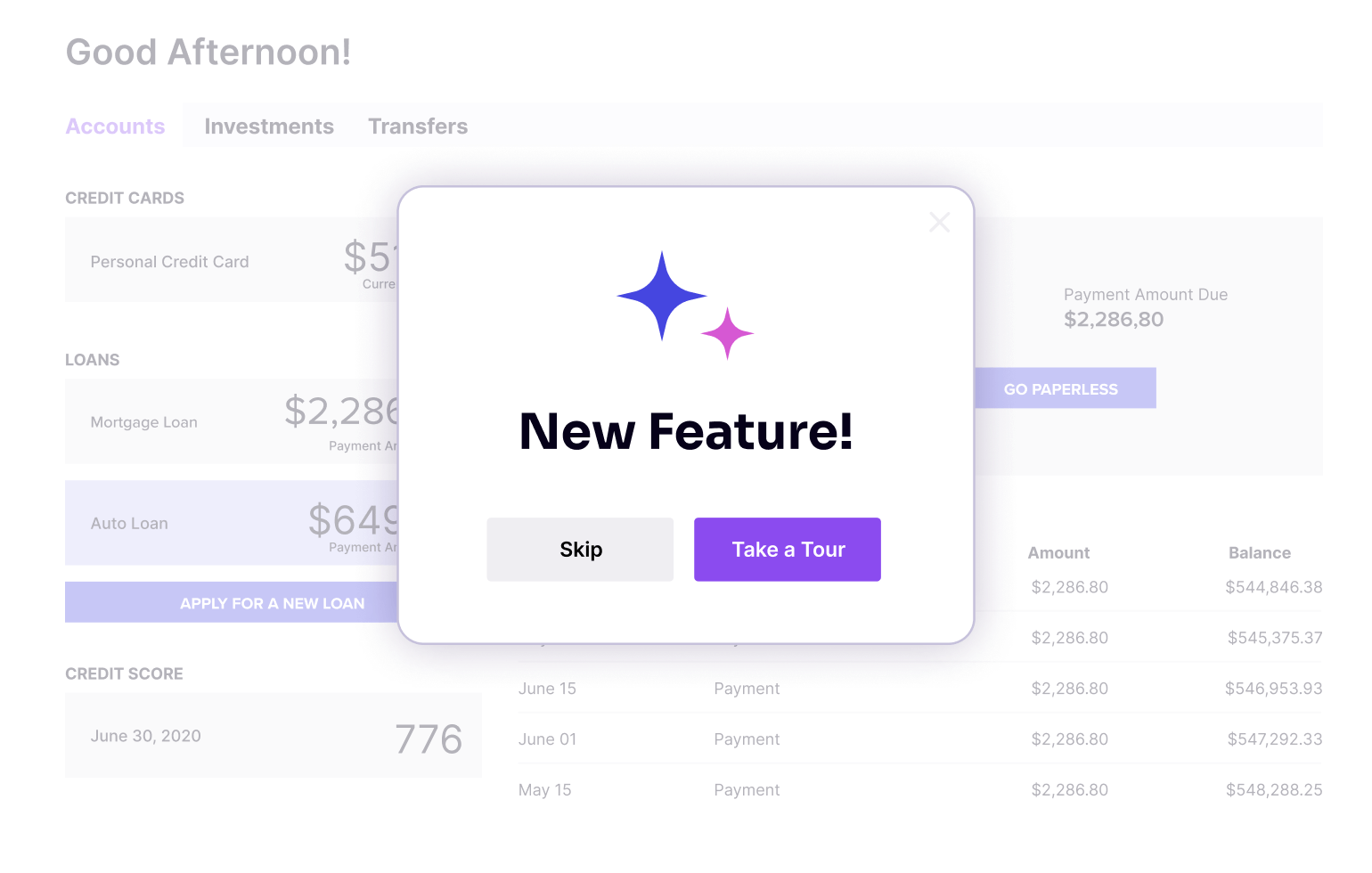
New features will never see significant adoption if the user base is unaware of them. So discoverability and the announcement process are important parts of driving feature adoption. Most companies employ several channels for communicating updates: blog, email, social, customer meetings, and in-app notifications.
There are a few considerations that can help shape a feature adoption strategy. The first is relevance. Users are much more likely to respond to announcements that matter to them. Few features are deeply relevant to all users, so announcements should be tailored to the most appropriate user segments. The second consideration is desired action. What does one want users to do upon reading the announcement? By delivering announcements as notifications and guidance in-app, companies can also measure whether new releases are delivering value and reduce the spike in support costs that often come with feature rollout.
Nelnet, an education technology platform, noticed an uptick in support calls from parents seeking tuition statements for tax purposes at the beginning of the school year. The team implemented an in-app guide to direct users to their annual payment summaries, and adoption of that specific feature rose 200%.
What constitutes successful adoption across these dimensions is going to vary from use case to use case, but it’s important to consider all four when assessing the outcome of any feature release.
How to drive higher feature adoption rates
Measuring feature adoption is important, but it’s only half the story. Once you’ve collected data and formed insights around which features users are and aren’t adopting, there are certain tactics you can use to improve your feature adoption. Here are four ways we recommend:
- Announce new features in-app: One of the best tools for announcing new features is your product itself. When you deliver feature announcements in-app using pop up guides or tooltips, you can ensure you’re reaching users when the information is most relevant. In the end, you want to make it as easy as possible for customers to find and use the new feature you’re promoting.
- Make the value (and desired action) clear: As you create in-app messages or other communications about a feature, use straightforward language that makes it clear what the value of this feature is. Similarly, be sure to clearly state or point users to the next action you want them to take–whether it’s to immediately use the feature, read documentation about it, or watch a guided demo.
- Drive adoption beyond the announcement: Once you’ve announced a new feature, the work doesn’t end there. Especially for features that are more intricate or require multiple steps in the workflow, it’s helpful to create in-app walkthroughs to guide users through the desired steps.
- Target your communications: Since your product likely has different types of users (e.g. different roles at the company, permissions, or technical proficiency), not every feature will be relevant to every user. Because of this, you should segment your users and target in-app communications about new features for these various groups. For every feature launch, think about who the target audience is and how you might need to adjust your communication strategy for different types of users.
Where can I learn more?
For those looking to dig a little deeper, Pendo has published a blog post “The two sides of driving feature adoption” as well as content on how to take a product-led approach to feature adoption.