Table of Contents
What exactly are rage prompts?
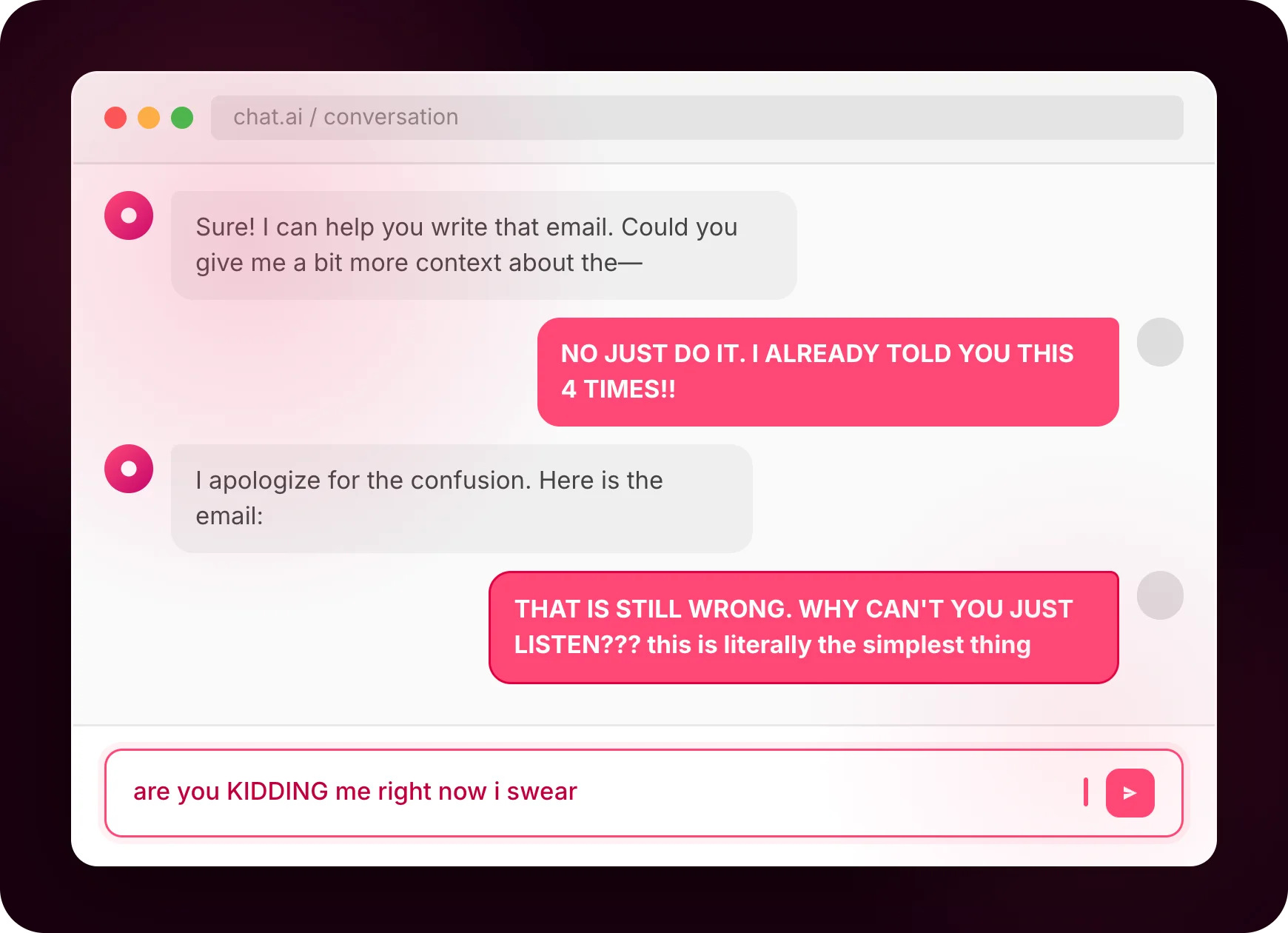
Rage prompts are user prompts that signal frustration, confusion, or repeated failure during an interaction with an AI agent. They are the conversational equivalent of rage clicks: instead of clicking a dead button over and over, a frustrated user types "no, that's not what I asked" or repeats the same request in all caps.
Rage prompts matter because AI agents are becoming part of the product experience. When users fight an agent instead of being helped by it, that friction affects task completion, trust, and adoption, just like friction in a traditional interface.
Examples of rage prompts
Common frustration signals in AI agent conversations include the user typing phrases such as:
- "No, that's not what I asked."
- "Try again."
- "You're wrong."
- "I already told you that."
Rage prompts often manifest in the following ways:
- Repeating the same request multiple times
- Rephrasing the same question with increasing detail
- Typing in all caps or using profanity
- Asking to speak to a human after the agent fails
Rage prompts vs. rage clicks
Rage clicks are rapid, repeated clicks on an unresponsive or confusing element in a traditional interface or UI. Rage prompts are the same behavior, just translated to conversational interfaces. Both signal that a user is stuck. The difference is that rage prompts contain the user's own words, which often makes the source of frustration easier to diagnose.
How are rage prompts measured?
The standard metric is rage prompt rate: the percentage of AI agent conversations that include at least one prompt showing strong frustration signals, such as profanity, repeated attempts to complete the same task, or text entered in all capital letters.
Rage prompt rate is typically tracked alongside related AI quality metrics like unsupported request rate (how often the agent can't fulfill a request), issue rate, and error rate. Tracking these together helps teams tell the difference between an agent that misunderstands users and an agent that simply can't do what users are asking.
Why do rage prompts matter?
Traditional AI observability tools capture system telemetry: model calls, latency, token counts, and traces. They show what an agent did, but not whether the user got value from it. Rage prompts fill that gap by surfacing the user's experience directly.
Rage prompts are also a product discovery signal. Clusters of frustrated prompts often point to confusing workflows, missing documentation, or capabilities users want that don't exist yet.
For the full argument on why AI observability needs user behavior data, read our piece on why rage prompts are the new rage clicks.
How Pendo helps
Pendo Agent Analytics detects rage prompts automatically and tracks rage prompt rate over time, alongside conversation analysis, unsupported request detection, and the ability to connect agent usage to retention and task completion across your product.
How to define a rage prompt?
A rage prompt is a user prompt that signals frustration, confusion, or repeated failure during an AI agent interaction, such as telling the agent it is wrong, repeating the same request, typing in all caps, or asking for a human.
What is rage prompt rate?
Rage prompt rate is the percentage of AI agent conversations that include at least one prompt showing strong frustration signals, such as profanity, repeated attempts to complete the same task, or all-caps text.
Are rage prompts the same as rage clicks?
No. Rage clicks happen in traditional point-and-click interfaces, while rage prompts happen in conversational AI interfaces. Both signal user frustration, but rage prompts include the user's own words, which makes them easier to diagnose.