
Table of Contents
What is vibe coding?
Vibe coding is an AI-driven software development approach where developers describe desired functionalities in natural language prompts. Large Language Models (LLMs) like ChatGPT or Claude then generate the corresponding code, shifting the developer’s role from manual coding to guiding and refining AI-generated outputs. Coined by Andrej Karpathy in 2025, vibe coding emphasizes intuition and creativity over traditional coding syntax and structure.
What is the origin and evolution of vibe coding?
The term “vibe coding” emerged from the AI community, highlighting a shift towards more intuitive coding practices. With advancements in LLMs, developers began leveraging AI to handle routine coding tasks, allowing them to focus on higher-level design and problem-solving. This evolution democratized software development, enabling individuals without formal coding backgrounds to build functional applications.
How does vibe coding work?
In vibe coding, developers interact with AI tools in a dynamic and collaborative workflow that leverages both natural language input and iterative code generation. The typical process includes:
- Describing features: Developers begin by articulating the application’s goals or specific features in plain language prompts. This step often resembles product ideation sessions, where user needs and business objectives are outlined.
- Prompt engineering: Fine-tuning the phrasing and specificity of prompts plays a crucial role in achieving high-quality results. Developers experiment with different instructions, formats, and levels of detail to guide the AI effectively.
- Code generation: Based on the prompts, the AI generates code—ranging from simple functions to complex UI components. Developers review this output for correctness, efficiency, and alignment with the intended functionality.
- Iterative refinement: This phase involves continuously updating prompts, tweaking code manually when necessary, and re-engaging the AI to improve the solution. It is common to cycle through several rounds of back-and-forth before reaching the desired outcome.
- Testing and validation: Developers perform unit tests, integration tests, and manual validation to ensure the generated code works as intended and doesn’t introduce regressions or security flaws.
- Deployment: Once validated, the feature is merged into the main codebase and deployed. Continuous monitoring tools like Pendo are often used post-deployment to analyze usage and performance.
- AI-powered monitoring: As vibe-coded features go live, intelligent analytics platforms track not just traditional metrics, but AI-specific signals like prompt patterns, agent interaction quality, and automated workflow success rates. Pendo Agent Analytics provides visibility into how users engage with AI-generated features, whether they're custom onboarding flows built through prompts or automated assistants created via LLM workflows. This closes the validation loop that traditional analytics miss, revealing whether your vibe-coded features truly resonate or need refinement.
This methodology fosters a powerful synergy between human intuition and AI efficiency, allowing developers to shift focus from syntax and boilerplate code to architecture, usability, and business impact.
What are the pros and cons of vibe coding?
Pros:
- Accelerated development: Rapid prototyping and iteration allow SaaS teams to move from idea to implementation much faster than traditional development. For example, a product manager can describe a feature—like a custom onboarding flow for enterprise users—and have a functioning prototype within hours, not days.
- Accessibility: Vibe coding lowers the barrier to entry for non-developers, enabling designers, product managers, and even customer success professionals to contribute to product development. Imagine a CS team member generating a basic reporting dashboard for user engagement metrics using AI, which a developer can then polish and integrate.
- Focus on creativity: By offloading routine and repetitive tasks to AI, developers can focus on what truly matters—innovative problem solving and UX. For instance, rather than manually coding every modal or button state, engineers can spend their time crafting a unique, seamless workflow for B2B trial conversions.
- Intelligent iteration: When combined with AI-powered analytics, vibe coding creates a feedback loop that's faster and more precise than traditional development cycles. Pendo Agent Mode, for example, can automatically surface insights about vibe-coded feature performance, generate hypotheses about user behavior, and even suggest refinements to LLM prompts based on actual usage patterns. For instance, if an AI-generated checkout flow has unexpected drop-off, Agent Mode can analyze the data and recommend specific prompt adjustments to improve the next iteration.
Cons:
- Potential for errors: AI-generated code may contain bugs, inefficient logic, or unintended behavior. For example, in a SaaS billing module, an AI might incorrectly apply tax logic across international regions, leading to compliance issues. Manual review and QA testing remain essential to ensure production-ready code.
- Security concerns: Without thorough review, AI-generated code can expose security vulnerabilities—such as open API endpoints or improper data validation. Imagine a scenario where a vibe-coded feature allows unrestricted file uploads without size limits or content checks—this can quickly become a vector for abuse.
- Over-reliance on AI: Depending too heavily on AI tools may diminish hands-on coding skills over time. For instance, a junior developer might struggle to debug or scale a user management feature built by AI if they never fully understood how it was constructed. To mitigate this, teams should ensure regular upskilling and code walkthroughs.
How does vibe coding affect SaaS development?
Vibe coding is particularly beneficial in SaaS development, where speed and adaptability are crucial. By leveraging AI, teams can quickly prototype features, test user interactions, and iterate based on feedback. This approach supports agile methodologies and continuous delivery models prevalent in SaaS environments.
For early-stage startups and teams experimenting with AI-driven development workflows, validating vibe-coded features doesn't require enterprise infrastructure. Pendo's free plan supports up to 500 monthly active users, making it accessible for teams just beginning their journey with AI-assisted development. As products scale, validation needs grow more sophisticated, requiring predictive churn modeling, AI agent analytics, or automated insight generation. For these and other use cases, Pendo's paid tiers provide the advanced intelligence layer that transforms experimental vibe coding into a production-grade development strategy.
What is the vibe coding process?
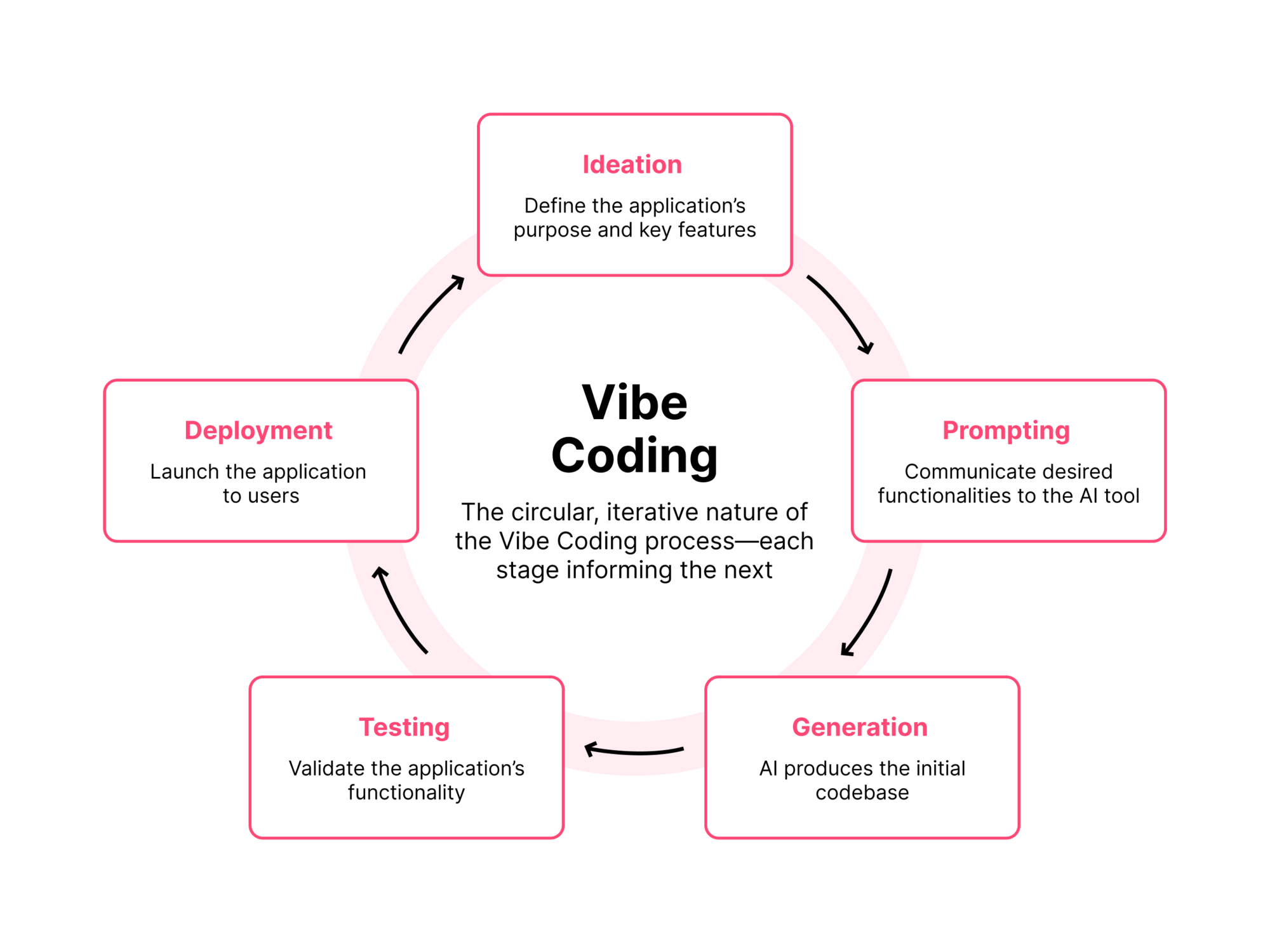
- Ideation: Define the application’s purpose and key features.
- Prompting: Communicate desired functionalities to the AI tool.
- Generation: AI produces the initial codebase.
- Review: Assess and refine the code for performance and security.
- Testing: Validate the application’s functionality.
- Deployment: Launch the application to users.
What are vibe coding best practices?
- Clear communication: Provide precise and detailed prompts to the AI.
- Continuous learning: Stay updated with AI tool capabilities and limitations.
- Thorough testing: Implement rigorous testing protocols to ensure reliability.
- Security audits: Regularly review code for potential vulnerabilities.
How to validate vibe-coded features effectively
Speed without validation is risk. As teams adopt vibe coding workflows, establishing validation frameworks becomes essential to ensure AI-generated features deliver real business value. Here's how leading product teams validate at the speed of AI development:
- Define success metrics before prompting: Before describing a feature to an LLM, establish clear behavioral metrics that define success. Instead of "build a dashboard," specify "create a dashboard that increases daily active usage by 15% within 30 days." This clarity in intent translates to better prompts and measurable validation criteria.
- Implement staged rollouts with behavioral tracking: Release vibe-coded features to small user cohorts first while tracking detailed interaction patterns. Pendo's segmentation capabilities let teams compare how different user groups engage with AI-generated features, revealing whether the code performs consistently across contexts.
- Monitor AI-specific quality signals: Traditional code review catches syntax errors, but vibe-coded features require behavioral review. Track metrics like task completion rates, time-to-value, error recovery patterns, and user sentiment to understand whether AI-generated code truly serves user needs.
- Create feedback loops between analytics and prompts: Use behavioral data to refine your LLM prompts iteratively. If analytics reveal that users abandon a vibe-coded workflow at a specific step, adjust your natural language description to emphasize that transition more explicitly in the next iteration.
- Establish guardrails for AI-generated complexity: Not every feature benefits from vibe coding. Use analytics to identify which types of features perform well when AI-generated versus those that require traditional development. This intelligence helps teams allocate resources optimally.
- Start small and scale intelligently: For teams new to vibe coding, beginning with Pendo's free analytics (supporting up to 500 MAUs) provides the validation foundation to experiment confidently. As your AI-driven development practice matures and you need predictive insights, agent tracking, or automated anomaly detection, upgrading to Pendo's advanced capabilities ensures your validation infrastructure scales alongside your product ambitions.
How does Pendo enhance vibe coding?
Vibe coding accelerates development, but success isn't measured in lines of code generated, it's measured in user outcomes. This is where Pendo transforms AI-driven development from a productivity experiment into a strategic advantage. Here's how Pendo's intelligence layer amplifies every phase of the vibe coding workflow:
- Validate AI-generated features with behavioral intelligence: Traditional analytics tell you what happened. Pendo tells you *why* and *what to do next*. Through detailed behavioral analytics, product teams gain unprecedented visibility into how users interact with vibe-coded features. If an LLM-generated onboarding sequence shows unexpected drop-off, Pendo doesn't just surface the metric, it reveals the exact step where users disengage, the common paths users take before abandoning, and segments that struggle most. This transforms debugging AI-generated code from guesswork into precision engineering.
- Monitor AI agents with purpose-built analytics: As teams move from vibe-coded features to full AI agents embedded in products, understanding agent performance becomes mission-critical. Pendo Agent Analytics provides the visibility you need to answer questions traditional tools can't: Are users finding value in your AI assistant? Which prompts drive the most engagement? Where do agent interactions break down? By tracking agent adoption, user intent, and conversation quality, teams can iteratively improve AI experiences with the same rigor they apply to traditional product development.
- Accelerate iteration with AI-powered insights: Vibe coding is inherently iterative: You prompt, generate, test, and refine. Pendo Agent Mode supercharges this cycle by automatically surfacing insights about feature performance and generating actionable recommendations. Through Agent Mode, teams can ask natural language questions like "Why did engagement drop on our AI-generated dashboard?" and receive comprehensive analysis in seconds. This conversational intelligence layer means product teams spend less time manually analyzing data and more time improving the prompts that drive their vibe-coded features.
- Close the feedback loop with real-time user input: The most effective vibe coding happens when developers have direct access to user sentiment. In-app polls and surveys allow teams to gather targeted feedback on AI-generated features the moment users interact with them. A product manager can launch a vibe-coded feature, immediately collect qualitative insights on what feels intuitive versus confusing, and refine their LLM prompts accordingly—all within a single development sprint.
- Guide users through AI-generated experiences: Even the most elegantly vibe-coded feature may require onboarding. With Pendo, teams can build contextual walkthroughs and tooltips that help users understand new AI-driven workflows without waiting for engineering resources. When a customer success team vibe-codes a new automation feature, they can simultaneously create intelligent guidance that adapts based on user behavior—ensuring adoption scales as fast as development.
- Track usage patterns that inform the next iteration: Pendo's usage analytics reveal not just adoption metrics, but the behavioral signals that inform better vibe coding. Which features do power users engage with most? Where do new users struggle? What interaction patterns predict long-term retention? These insights flow directly back into prompt engineering, helping teams describe features to LLMs with precision grounded in actual user behavior rather than assumptions.
- Accessible for teams at any stage: Whether you're a solo founder experimenting with your first vibe-coded MVP or an enterprise team scaling AI-driven development across multiple products, Pendo meets you where you are. Start free with up to 500 monthly active users—giving early-stage teams full access to behavioral analytics, in-app guides, and feedback collection to validate AI-generated features without upfront investment. As your product grows and validation needs become more sophisticated, seamlessly unlock advanced capabilities like Pendo Predict for churn forecasting, Agent Analytics for AI assistant tracking, and Pendo AI's Agent Mode for conversational insights that make your vibe coding practice smarter with every iteration.
By integrating Pendo into the vibe coding workflow, SaaS teams transform AI-assisted development from a speed play into a strategic capability. Every AI-generated feature becomes a learning opportunity. Every user interaction informs the next prompt. Every behavioral signal compounds into product intelligence that makes your vibe coding practice smarter over time. This is how leading teams validate, scale, and continuously improve AI-driven development—ensuring that the features generated at the speed of vibe coding deliver lasting value at the speed of user expectations.
Vibe coding represents a transformative approach to software development, blending human creativity with AI efficiency to deliver features at unprecedented speed. Yet velocity alone doesn't guarantee success. The teams that truly excel combine rapid AI-assisted development with intelligent validation systems that ensure every generated feature drives measurable user value.
Platforms like Pendo provide the essential analytics layer that bridges code generation and user outcomes, transforming vibe coding from an experimental practice into a strategic capability. By validating AI-generated features through behavioral intelligence and continuously refining based on real usage patterns, product teams can maintain the speed advantages of vibe coding while eliminating the risk. This is how modern SaaS development works: AI handles the syntax, humans guide the strategy, and intelligent analytics validate the results.