Table of Contents
What is a digital adoption platform (DAP)?
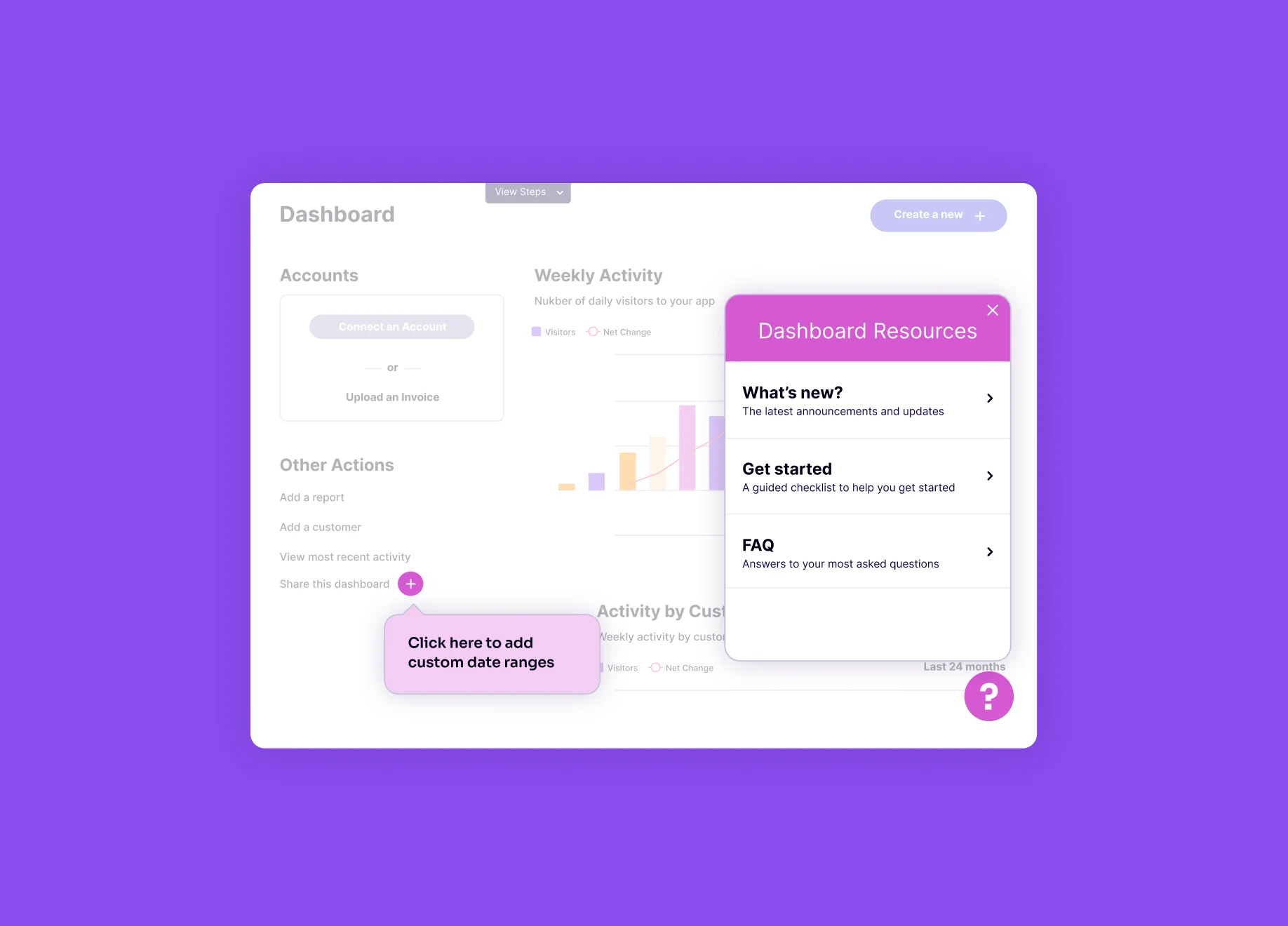
DAP stands for digital adoption platform—software layered on top of another software product, app, agent, or website to help users achieve proficiency by guiding them through key tasks and providing contextual information as they navigate. You may also hear DAPs referred to as digital adoption solutions or digital adoption tools, though these terms are often used interchangeably in the market. A true digital adoption platform combines in-app guidance, analytics, and feedback capabilities in a single solution, serving both customer-facing product teams and internal IT, Revenue, or HR teams driving employee software adoption.
How do digital adoption platforms work?
A digital adoption platform works by installing a lightweight code snippet or browser extension that layers guidance and analytics on top of existing software applications. Once installed, the DAP can:
Track user behavior: The platform captures clicks, page views, feature usage, and navigation patterns without requiring changes to the underlying application code.
Deliver contextual guidance: Based on where users are in the application and their behavioral history, the DAP displays relevant walkthroughs, tooltips, or announcements.
Collect feedback: In-app surveys and feedback prompts appear at strategic moments to capture user sentiment and identify friction points.
Surface insights: Analytics dashboards aggregate usage data across users, segments, and time periods, revealing adoption trends and opportunities.
Modern DAPs deploy without heavy IT involvement—product managers, customer success teams, and IT professionals can typically create and launch adoption content without writing code. This no-code approach enables faster iteration and keeps adoption strategies aligned with rapidly changing software.
For internal-facing use cases, DAP can provide consistent guidance across the entire software portfolio, creating a unified experience for employees navigating different tools throughout their workday.
Why do organizations need a digital adoption platform?
Organizations invest heavily in software—whether customer-facing products or internal enterprise applications—but that investment only pays off when users actually adopt and use the tools effectively. A digital adoption platform bridges the gap between software deployment and software proficiency.
For product teams, a DAP ensures customers discover and adopt the features that drive retention and expansion.
For IT, Revenue, and HR teams, a DAP reduces the burden of training employees on complex enterprise software while cutting support ticket volume.The need for a digital adoption platform has accelerated as organizations manage increasingly complex software portfolios, including AI tools and agents. The average enterprise now uses hundreds of SaaS and AI applications, and employees spend significant time navigating unfamiliar interfaces. A DAP provides consistent, in-context guidance across this fragmented landscape.
Here are some ways DAPs take digital adoption to the next level:
- A DAP can significantly boost user productivity by speeding the onboarding process, smoothing workflows, and reducing time spent on troubleshooting.
- Businesses lose a ton of money every year due to poor software adoption. DAPs combat these costs by ensuring users are adequately trained and equipped to utilize software effectively.
- The right DAP can help ensure internal governance measures and best practices are followed, further enhancing efficiency.
- In the end, the increase in user productivity and level of comfort with apps will invariably trickle down to improved customer experiences.
However, the robust analytics the right digital adoption platform provides goes even further. While effective onboarding is critical, the greater value lies in ongoing learning and measurement. To maximize the impact of a DAP, it’s vital to leverage the data it collects.
- A DAP can collect and analyze valuable data on user behavior within the company’s software, providing insights into areas that might be causing user roadblocks and generating a flood of IT support tickets.
- Further, by analyzing user behaviors and tracking metrics (such as completion rates for in-app guides or time spent on specific tasks), a DAP can help organizations identify areas for potential improvement, thus further refining their digital adoption strategy.
This data-driven approach ensures that your DAP investment truly delivers a positive return.
Everest Group has named Pendo a digital adoption platform leader
How does AI enhance a digital adoption platform?
AI transforms a digital adoption platform from a reactive guidance tool into a proactive adoption engine. Rather than relying solely on manually triggered walkthroughs, an AI-powered DAP can analyze user behavior patterns, predict where users will struggle, and deliver personalized guidance before friction occurs.
Key AI capabilities in modern digital adoption platforms include:
Automated content generation: AI can draft in-app guides and tooltips based on product changes, reducing the manual effort required to keep adoption content current.
Behavioral prediction: Machine learning models identify users at risk of churn or confusion, enabling proactive intervention through targeted guidance.
Natural language assistance: AI-powered search and chat within the application help users find answers instantly without submitting support tickets.
Agent analytics: As AI agents become embedded in enterprise software, DAPs with agent analytics capabilities help organizations measure AI adoption and outcomes alongside human user behavior.
This combination of AI, analytics, and automation makes a modern DAP essential for both customer success teams improving product adoption and IT teams driving employee proficiency across the software stack.
What are the benefits of a digital adoption platform?
Digital adoption platforms provide efficient, in-app onboarding that quickly gets new hires up to speed, but the benefits don’t end there. A digital adoption platform also enhances the overall user experience and drives long-term value, not only for the user of the software but for the teams developing and supporting the software as well. Let’s dig deeper into some key benefits.
Faster onboarding
Traditional onboarding methods often rely on lengthy manuals, video tutorials, or classroom sessions. These can be time-consuming and overwhelming for new hires eager to contribute (not to mention those who must create and update these one-size-fits-all training materials). DAPs slash the time new users take to learn software (not to mention the tedium they experience) by replacing:
- Text-heavy user manuals of traditional onboarding with interactive walkthroughs with step-by-step guidance
- Generic lengthy video tutorials with contextualized microlearning modules focused on specific tasks
- In-person training sessions with on-demand, in-app support that is readily available when and where it’s needed
By replacing passive and often tedious learning methods with interactive self-service experiences, DAPs significantly reduce onboarding time and empower new users to become productive much faster.
Increased user engagement
Traditional software interfaces can be complex and daunting, leading to user frustration and disengagement. DAPs tackle this challenge by providing:
- Interactive walkthroughs: These user-friendly guides walk users through specific workflows and functionalities within the software itself, providing real-time instruction and eliminating the need to switch between applications and reference manuals.
- Microlearning modules: Bite-sized learning modules, delivered within the application right when and where needed, allow users to acquire new skills and knowledge at their own pace. This just-in-time learning — including embedded video and other media — is more engaging and effective than traditional, lengthy training sessions.
- Contextual help bubbles: Another on-demand resource, these help bubbles offer immediate clarification and support within the software interface, right where users need it most.
By making learning an integrated part of the user experience, DAPs keep users engaged with the software and empower them to explore its full potential.
Reduced support tickets
New users or those unfamiliar with specific software features — whether employees or customers — often rely on IT or customer support for assistance. Handling the software support tickets, phone calls, or live chats required to assist these users can cost a company millions, but DAPs can significantly reduce the burden by providing self-service resources.
In-app guides, FAQs, knowledge base articles, and even context-sensitive videos can empower users to find answers to common questions independently, avoiding many support cases. As mentioned earlier, on-demand contextual help bubbles provide immediate clarification within the workflow, eliminating the need to wait for IT or customer support assistance. DAPs can also tailor the learning experience to individual user needs and roles, ensuring each user receives relevant guidance and avoiding irrelevant information overload.
By equipping users with the resources they need to solve problems independently, DAPs do more than free up IT and customer support resources. They also create a more self-sufficient and productive workforce and customer base.
What are the core features of a digital adoption platform?
A comprehensive digital adoption platform includes several integrated capabilities that work together to drive software proficiency for both customers and employees:In-app guidance: Walkthroughs, tooltips, and checklists that guide users through tasks without leaving the application. The best DAPs allow non-technical teams to create and deploy guides without engineering support.
Product analytics: Usage data that reveals how users navigate software, which features drive value, and where they encounter friction. Analytics should cover both web and mobile applications.
Session replay: Visual playback of user sessions that helps teams understand the "why" behind behavioral data, identifying UX issues and training gaps.
User feedback and NPS: In-app surveys and feedback collection that capture user sentiment at key moments, connecting qualitative insights to quantitative usage data.
Knowledge center: A searchable, always-available resource hub embedded within the application where users can find guides, FAQs, and documentation on demand.
Segmentation and targeting: The ability to deliver different experiences to different user groups based on role, behavior, lifecycle stage, or custom attributes.
A true digital adoption platform unifies these capabilities in a single solution rather than requiring organizations to stitch together point tools. This unified approach ensures consistent data, reduces tool sprawl, and enables teams to act on insights without switching between dashboards.
What is the difference between a digital adoption platform and other methods of encouraging digital adoption?
While traditional software app onboarding methods like user manuals, video tutorials, and in-person training have their place, digital adoption platforms offer a more comprehensive and effective approach to software adoption. Here are some key differences to consider.
Traditional methods
- User manuals (whether printed or PDFs) tend to be lengthy and text-heavy, and they can be overwhelming for new users, requiring a significant time investment to understand. They lack personalization and may not address specific user needs or workflows.
- Video tutorials can’t be tailored to an individual’s role or learning style. They often require users to switch between the software and the video, disrupting the learning flow. Some training videos are all-in-one, covering everything about the software, but even if broken into shorter videos, they require users to hunt for the exact information they need.
- In-person training allows for real-time interaction and Q&A, but coordinating it is expensive and time-consuming, especially for geographically dispersed users. In addition, the information users learn in the classroom might not be readily available or easily accessible, even if the class is recorded.
Digital adoption platforms (DAPs)
- Personalization: Unlike static manuals and tutorial videos, DAPs can tailor the learning experience to individual user needs and roles. Users receive only the information relevant to their specific tasks, avoiding information overload and tedious searching through lengthy text or videos.
- Real-time guidance: DAPs deliver contextual help and walkthroughs right within the software, eliminating the need to switch between applications or reference separate materials. Users receive immediate support right when and where they need it, minimizing disruption and frustration.
- Data-driven insights: DAPs track user behavior and engagement, providing valuable insights into user adoption patterns and potential roadblocks. This data allows companies to refine their digital adoption strategy and ensure users get the most out of the software.
Combining these features gives DAPs a more engaging, efficient, and data-driven approach to software adoption than traditional methods. They encourage and empower users to learn at their own pace within the software environment they’re required to use and provide valuable data to continuously improve the learning experience.
How do I choose a digital adoption platform?
Selecting the right digital adoption platform is crucial to maximizing its impact on your organization’s users, whether customers or employees. Here are some key capabilities to consider when choosing between DAPs.
- User segmentation: When considering which DAP to use, you should be mindful that different users will have different needs and levels of software experience. Choosing a platform that allows for nimble segmentation and targeting across categories is critical to ensure each user gets the tailored guidance and help they need — but also not bombarded with information they don’t.
- Ease-of-use: The platform itself should be user-friendly and intuitive, allowing administrators to create and manage content such as in-app guides and contextual help without requiring extensive technical expertise. A smooth user experience for administrators and end-users is essential for successful adoption.
- Content creation: Look for a DAP that offers a variety of content creation tools, such as in-app guides, walkthroughs, tooltips, and microlearning modules. Creating engaging and interactive content is vital to keeping users engaged.
- Customization: A robust DAP allows for customization of the learning experience to align with your company branding and specific workflows. This alignment ensures a seamless integration with your existing user interface and reinforces brand recognition.
- Analytics and reporting: Data-driven insights are crucial for measuring the success of your digital adoption strategy. Choose a DAP that provides comprehensive analytics on user behavior, engagement metrics, and content performance. This data allows you to identify areas for improvement and optimize your learning materials for maximum impact.
- Integrations: Consider a DAP that integrates with your existing software stack, including Learning Management System (LMS), CRM, marketing and workflow automation software, IT and customer support platforms, and chosen cloud services. Seamless integrations ensure a streamlined user experience and avoid data silos.
- Scalability: As your company grows and your software needs evolve, your DAP should be able to scale accordingly. Choose a platform that can accommodate future growth and support adding new features and functionalities.
- Feedback: An effective DAP will help teams actively incorporate user feedback into their planning process, making sure it doesn’t get lost in a feedback black hole.
By carefully considering these factors, you can choose a digital adoption platform that empowers your workforce, streamlines software adoption, and delivers a positive ROI.
How do I measure the return on investment (ROI) of a digital adoption platform?
Measuring its impact and value to the organization is just as important as deploying a digital adoption platform in the first place. Purchasing software for your team is a big financial commitment, and the right digital adoption platform will ensure that your investment pays off. But quantifying the value (and therefore the ROI) on any piece of software — including a DAP — can be difficult if you don’t know which metrics to track.
The right digital adoption platform will let companies quantify the impact of their digital adoption strategy in numerous ways. Teams should be able to customize user training and onboarding and then measure the effectiveness of these efforts. For example, they might examine how the volume of support ticket requests decreases following new DAP-enabled training. Or they might track the decreased time spent on specific tasks after deploying new in-app guides and whether that affected critical KPIs. However, you should not measure the ROI of a digital adoption platform by the success of a single guide but rather by how effectively the DAP drives adoption of the complete set of features your software has to offer.
Here are some key metrics and how you can effectively measure the ROI of your DAP using comprehensive analytics.
Reduced onboarding time and costs
Efficient in-app onboarding is a core benefit of DAPs. To measure this impact, you can track time savings by monitoring the time required for new users to become proficient with the software using the DAP compared to traditional onboarding methods. This time saved translates to a reduction in onboarding costs and allows new users to leverage your software more quickly.
Increased user productivity
Beyond onboarding, DAPs can significantly boost overall user productivity. You can quantify this in different ways.
- Measure task completion rates by examining how DAP-driven, in-app guides and walkthroughs impact the completion times of specific tasks. Faster task completion translates directly to increased productivity.
- Analyze the reduction of support tickets by tracking the number of IT or customer support tickets related to the software before and after implementing a DAP. A decrease in tickets indicates that users can find answers and resolve issues independently, freeing up IT or customer support resources for more complex tasks.
Improved user engagement and software adoption:
A DAP can substantially improve user engagement with the software and drive overall adoption rates.
- Monitor user activity by allowing the DAP to track user activity within the platform, including their guide completions and content usage. Analyze this data to identify areas of high engagement as well as areas where users might be struggling. This allows you to refine your content strategy and ensure users get the most out of the DAP.
- Measure increased feature utilization by tracking how frequently users access and use new features after launching them with DAP content support. This demonstrates the platform’s effectiveness in driving user adoption of the software’s full potential.
Remember, the full value of a DAP is measured by more than any one individual guide. By combining data on reduced onboarding costs, increased productivity, and improved user adoption, you can calculate the overall ROI of your DAP investment. (Note that 70% of Pendo customers report a positive ROI within 6-8 months.)
What are the best digital adoption platforms?
The last thing a company should do is pick a digital adoption platform that creates more problems than it solves or becomes another hurdle and general burden to users. Keeping in mind all the other essential capabilities of a DAP described on this page, here are three final considerations when determining which DAP is suitable for your organization.
Beware of complex onboarding: The best digital adoption platforms offer users simple, streamlined experiences and interfaces that are intuitive and user-friendly regardless of one’s technical background or level of expertise.
Avoid chaotic interfaces: Ensure the DAP enables streamlined support, allowing administrators to manage all of their needs from one place rather than constantly having to navigate among various tools and dashboards.
Insist on dedicated support: Just as important, the best digital adoption platforms are more than just their software. They come with a support team committed to partnering with you to set you up to succeed.
By prioritizing these factors, you can identify a DAP and DAP vendor that can genuinely streamline software adoption and empower your workforce, avoiding the pitfalls of cumbersome solutions.
Where can I learn more about digital adoption platforms?
For those looking to become more familiar with digital adoption platforms, Pendo has published information on how to accelerate software adoption and increase employee productivity.