Table of Contents
What is product ops?
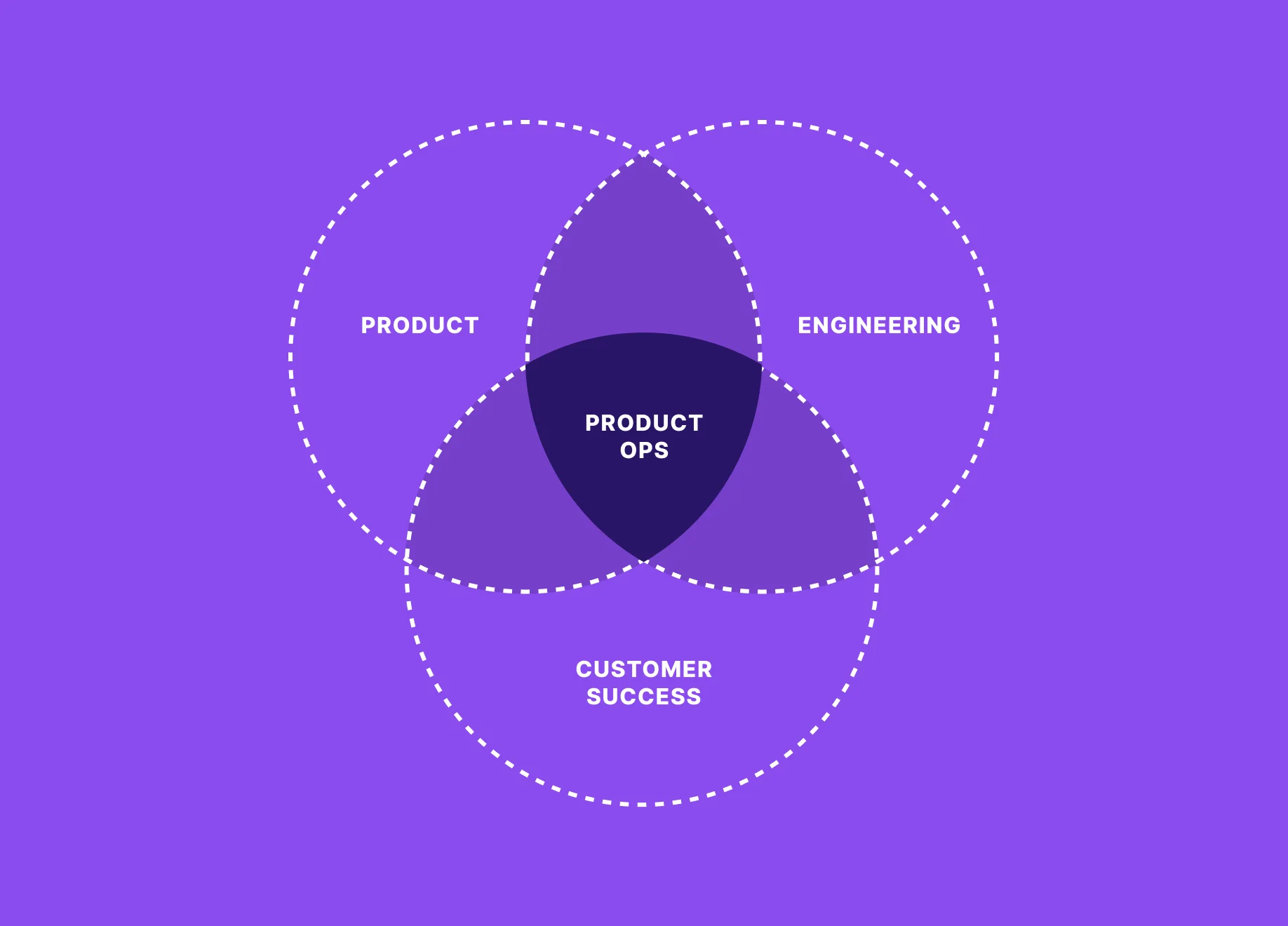
Product ops (short for product operations) is an operational function that optimizes the intersection of product, engineering, and customer success. It supports the R&D team and their go-to-market counterparts to improve alignment, communications, and processes around the product. Effective product ops teams accelerate feedback loops, increase efficiencies, and improve feature adoption.
Product ops can be thought of as a role (or team) within an organization, as well as a skill product professionals can develop. Specific priorities within the product ops function may vary based on company maturity, industry, and the nature of the product itself.Product operations (product ops) is an operational function that optimizes the intersection of product, engineering, and customer success. It supports R&D teams and go-to-market counterparts to improve alignment, communications, and processes around the product. Effective product ops teams accelerate feedback loops, increase efficiencies, and improve feature adoption.
As companies scale, product operations becomes essential infrastructure—similar to how sales operations and marketing operations emerged to support their respective teams. Product ops exists both as a dedicated role (typically starting with a product operations manager) and as a skill set that product professionals develop. Specific priorities within the function vary based on company maturity, industry, and product complexity.
According to recent industry research, 75% of software providers now rely on insights from embedded product analytics to inform product decisions, making product ops a critical function for data-driven product teams.
How product operations drives efficiency and decision-making
Product operations creates the systems, processes, and data infrastructure that enable product teams to scale effectively without sacrificing velocity or quality. As product organizations grow from a handful of product managers to dozens, product ops ensures consistent execution across the entire portfolio.
Product operations delivers value across eight key areas:
- Data infrastructure and insights: Product ops establishes analytics frameworks and maintains data quality so product teams can make evidence-based decisions rather than relying on intuition or incomplete information
- Tools ecosystem management: Product ops evaluates, implements, and optimizes the product tech stack—from analytics platforms like Pendo to roadmapping tools—ensuring teams have the right capabilities without redundant or underutilized software
- Process standardization: Product ops creates repeatable workflows for feature requests, product reviews, launch planning, and cross-functional collaboration that reduce friction and eliminate operational bottlenecks
- Experimentation frameworks: Product ops manages testing calendars, tracks experiment results, and standardizes A/B testing methodologies so teams can validate ideas faster and learn more systematically
- Cross-functional alignment: Product ops facilitates communication between product, engineering, design, sales, marketing, and customer success to ensure everyone works from the same strategic priorities
- Customer intelligence aggregation: Product ops consolidates feedback from support tickets, user interviews, NPS surveys, and usage data to surface patterns and prioritize what customers actually need
- Launch orchestration: Product ops coordinates release schedules, go-to-market timing, and internal enablement to ensure new features reach users effectively and sales teams can sell them confidently
- Strategic resource allocation: Product ops provides portfolio visibility and data-driven recommendations that help leadership allocate engineering capacity to the highest-impact initiatives
When companies typically invest in product operations:
Most organizations establish dedicated product ops when they experience specific scaling challenges: product managers spending more than 30% of their time on administrative tasks rather than strategy, data scattered across multiple systems with no single source of truth, inconsistent processes causing feature delays or miscommunication, or rapid team growth making coordination increasingly difficult.
Companies often start building product ops capabilities once they reach 5-10 product managers or after Series B funding when product portfolio complexity demands operational support.
Why is product ops important?
For product-led companies, the product is the focal point for each stage of the customer journey—from trial and purchase all the way through onboarding, expansion, and referrals—and product ops is key to the optimization of that experience. Just as sales ops, marketing ops, and DevOps became essential for their respective teams, product teams also benefit from an operational complement.
Product ops pros are often responsible for helping product management make more reliable decisions by equipping them with relevant usage data. Because product data is collected automatically (no manual entry, like with a CRM, for example), it tends to be among the “cleanest” data available to decision-makers. Gartner predicts that by 2021, 75% of software providers will rely on insights from embedded product analytics software to inform product decisions and measure customer health.
For example, when their business saw an unexpectedly high number of new users, the product ops team at Firefly Learning turned to product data to understand which features this new cohort of users accessed the most. They then shared these insights with the broader product team to help focus efforts on the areas of the product that were most valuable.
What does product ops do?
Product ops responsibilities fall into five core areas:
- Tools management and optimization: Product ops owns the product tech stack, evaluating and implementing platforms like Pendo for analytics, in-app guidance, and user feedback collection. They establish best practices for tool usage, prevent tool sprawl, and ensure teams extract maximum value from existing investments. This includes managing integrations between systems and maintaining data flow across the product ecosystem.
- Data collection and analysis: Product ops collects, organizes, and analyzes both quantitative and qualitative product data, then enables the entire organization to make decisions based on evidence rather than assumptions. Data sources include product usage analytics, Net Promoter Score (NPS), feature adoption rates, customer feedback, feature requests, and support tickets. Product ops transforms this raw data into insights about user behavior, feature performance, and product-market fit.
- Experimentation frameworks: Product ops eliminates friction in the product experimentation process by tracking, sequencing, and implementing A/B tests and feature releases. They create standardized processes for hypothesis formation, test design, result analysis, and decision-making that help teams learn faster and validate ideas before full launches.
- Cross-functional strategy and alignment: Product ops fosters collaboration across product, engineering, design, sales, customer success, and marketing teams. They use product insights to identify improvement opportunities, inform business strategy, and ensure everyone operates from a shared understanding of product performance and priorities. This alignment reduces duplicative work and ensures teams focus on the highest-impact initiatives.
- Leadership advisory: Product ops serves as a trusted advisor to CPOs, VPs of product, and R&D leadership by providing data-driven recommendations on portfolio prioritization, resource allocation, and strategic direction. They translate complex usage patterns into clear narratives that support executive decision-making.
Product operations vs. product management: complementary functions
While product operations and product management work closely together, they serve distinct purposes within the product organization. Understanding the difference helps companies structure teams effectively and avoid confusion about responsibilities.
| Aspect | Product Operations | Product Management |
|---|---|---|
| Primary focus | Internal enablement and efficiency | External customer needs and strategy |
| Key deliverables | Processes, data frameworks, tools | Product roadmap, features, positioning |
| Success metrics | Team velocity, data quality, operational efficiency | Product adoption, revenue, customer satisfaction |
| Time horizon | Ongoing systems and infrastructure | Individual feature releases and iterations |
| Main stakeholders | Product team, cross-functional partners | Customers, engineering, executives |
| Decision-making | How the product team operates | What the product should do |
Why both functions matter: Product managers determine what to build based on customer needs and market opportunities. Product operations ensures the product team can execute efficiently with the right data, tools, and processes. Together, they create a high-performing product organization. For example, a product manager might identify through customer conversations that users need better reporting capabilities. Product operations would support this by: providing usage data showing which current reports users access most frequently, coordinating the A/B test to validate design concepts, managing the analytics implementation to track adoption of the new feature, and facilitating the go-to-market process with sales enablement. Without product ops, product managers spend excessive time on operational tasks—setting up analytics, coordinating launches, compiling feedback—rather than focusing on product strategy. Companies with strong product ops functions report product managers spending 70% of their time on strategic work versus 40% in organizations without dedicated product ops support.
Why does a company need product ops?
Companies establish product operations for three primary reasons: freeing product managers from operational overhead, improving cross-functional collaboration, and making better decisions through comprehensive product intelligence.
Reducing product manager operational burden: The most immediate benefit is removing time-consuming operational tasks from product managers' responsibilities. Without product ops, PMs spend significant time setting up analytics, compiling feedback from multiple sources, coordinating launches, maintaining documentation, and responding to ad-hoc data requests. Product ops handles these activities, allowing product managers to focus on strategy, customer research, and defining what to build.
Enabling data-driven decision-making: Product ops establishes the data infrastructure and analytical frameworks that transform raw usage information into actionable insights. They ensure product teams can answer critical questions quickly: Which features drive retention? Where do users experience friction? What correlates with expansion revenue? By making data accessible and reliable, product ops helps teams make evidence-based decisions rather than relying on intuition or anecdotes.
Scaling product team effectiveness: As product organizations grow, coordination complexity increases exponentially. Product ops creates the systems, processes, and communication cadences that maintain alignment across expanding teams. They ensure best practices spread consistently, prevent duplicative work, and facilitate knowledge sharing across the organization.
Improving product launches and adoption: Product ops orchestrates go-to-market coordination, ensuring features launch successfully with appropriate enablement for sales teams, communication to customers, and measurement of adoption. They reduce the time between shipping features and seeing customer impact by streamlining the path from development to user hands.
Companies with dedicated product ops functions report measurably better outcomes: faster feature velocity, higher product manager satisfaction, improved cross-functional relationships, and better alignment between product investments and business results.
Frequently asked questions about product operations
What's the difference between product operations and product management?
Product management focuses on what to build based on customer needs and market opportunities. Product operations focuses on how the product team operates—establishing data frameworks, tools, processes, and coordination mechanisms that enable efficient execution. Product managers define strategy and features; product ops ensures teams can execute effectively.
When should a company invest in product operations?
Most companies establish product ops when they reach 5-10 product managers or when operational complexity begins impacting velocity. Common triggers include: product managers spending more than 30% of time on administrative work, data scattered across multiple systems, inconsistent processes causing delays, or difficulty coordinating across growing product teams. Companies typically make this investment after Series B funding or when product portfolio complexity demands operational support.
What tools does product operations need?
Product ops teams require tools across five categories: product analytics (usage tracking and behavior analysis), user feedback collection (surveys, NPS, feature requests), in-app guidance (announcements and onboarding), experimentation platforms (A/B testing), and collaboration systems (documentation and communication). Many organizations consolidate these functions into integrated platforms like Pendo rather than maintaining separate point solutions for each capability.
How does product operations measure success?
Product ops success metrics typically include: product manager time spent on strategic work (target 70%+ vs operational tasks), data quality and accessibility scores, cross-functional satisfaction ratings, feature launch velocity, time from insight to decision, and tool adoption rates. Leading indicators include reduction in duplicative analyses, faster data request response times, and improved alignment scores from cross-functional partners.
Does product operations replace product managers?
No. Product operations complements product management by handling operational infrastructure, allowing product managers to focus on customer research, strategy, and feature definition. The functions work together: product managers set direction and priorities, while product ops provides the data, tools, and processes that enable effective execution.
Where can I learn more about product ops?
In partnership with Product Collective, Pendo published The Rise of Product Ops, an e-book on product ops, including a breakdown of its responsibilities, characteristics of a successful product ops person, and where the function fits within the larger product environment. In it you can also find insights from a diverse array product ops practitioners, and advice for getting started with product ops.
How product ops drives collaboration in a product-led organization