Los gerentes de producto nunca habían tenido tantas herramientas de IA para elegir. Eso es parte del problema.
La mayoría de las listas de "mejores herramientas de IA para PMs" tratan cada función de IA como un producto separado. No es útil ni preciso. Las funciones de IA de Amplitude y las de Mixpanel no son herramientas independientes que se compran — son capacidades dentro de plataformas que ya conoces. La pregunta más útil no es "¿cuáles son las 10 herramientas que debería usar?", sino "¿cuáles son las 10 capacidades de IA que mi flujo de trabajo como PM realmente necesita, y qué plataforma ofrece cada una de la mejor manera?"
Esta guía desglosa las 10 capacidades de IA que los gerentes de producto deberían evaluar en 2026: qué resuelve cada una, qué plataformas las ofrecen bien y cómo saber si realmente las necesitas.
Respuesta rápida: ¿Qué capacidades de IA necesitan los gerentes de producto en 2026?
Las capacidades de IA que los gerentes de producto deberían evaluar en 2026 son: inteligencia de producto continua (Novus by Pendo), redacción y síntesis de propósito general (ChatGPT Enterprise, Claude), estrategia de producto y síntesis de comentarios (Productboard, a través de su agente Spark), codificación e instrumentación asistidas por IA (Cursor), descubrimiento hasta entrega nativo de Atlassian (Jira Product Discovery con Rovo), análisis de datos ad hoc (Claude), IA conversacional nativa de Workspace (Gemini), captura de reuniones y síntesis de investigación (Granola), colaboración de diseño asistida por IA (Figma) y facilitación de talleres asistida por IA (Miro).
Capacidades de IA para gerentes de producto
| # | Capability | Platform | PM workflow |
|---|---|---|---|
| #1 | CapabilityContinuous product intelligence | PlatformNovus by Pendo | PM workflowInstrument, monitor, iterate |
| #2 | CapabilityGeneral-purpose AI assistant | PlatformChatGPT Enterprise, Claude | PM workflowPRDs, synthesis, stakeholder comms |
| #3 | CapabilityProduct strategy and feedback synthesis | PlatformProductboard (Spark) | PM workflowDiscovery, prioritization, roadmapping |
| #4 | CapabilityAI-assisted coding and instrumentation | PlatformCursor | PM workflowSpec-to-code, technical PM workflows |
| #5 | CapabilityAtlassian-native discovery-to-delivery | PlatformJira Product Discovery + Rovo | PM workflowDiscovery-to-delivery alignment |
| #6 | CapabilityAd hoc data analysis and reasoning | PlatformClaude | PM workflowUsage analysis, data exploration |
| #7 | CapabilityConversational AI assistant, Workspace-native | PlatformGemini | PM workflowDrafting, research, summarization |
| #8 | CapabilityMeeting capture and research synthesis | PlatformGranola | PM workflowCustomer calls, sprint planning, design reviews |
| #9 | CapabilityAI-assisted design collaboration | PlatformFigma | PM workflowDiscovery, validation, design handoff |
| #10 | CapabilityAI-assisted workshop facilitation | PlatformMiro | PM workflowPlanning, brainstorming, alignment |
Cómo usar esta lista
Esta lista no está ordenada por calidad. Está organizada según las necesidades del flujo de trabajo de PM. Las herramientas aquí son suficientemente distintas —un IDE de programación, una app de notas de reuniones, un agente de producto, un modelo de propósito general— como para que compararlas con un único criterio no sería honesto.
Comienza con la capacidad que describe tu mayor cuello de botella y luego evalúa la plataforma indicada para ella. Si tu equipo está perdiendo contexto entre las llamadas con clientes y los PRDs, comienza en la fila 8. Si tu producto está cambiando más rápido de lo que tu instrumentación puede seguir, comienza en la fila 1. Si necesitas crear un prototipo antes de involucrar al equipo de ingeniería, empieza en la fila 4.
El stack de IA adecuado para un PM no es el más largo. Es el que elimina la fricción en los puntos correctos de tu flujo de trabajo.
Las 10 principales capacidades de IA para product managers en 2026
1. Inteligencia de producto continua — Novus.ai
Ideal para: Inteligencia de producto continua, monitoreo posterior al lanzamiento y flujos de trabajo de agentes de producto Flujo de trabajo del PM: Construir, instrumentar, monitorear, iterar
La mayoría de las herramientas de IA ayudan a los PMs a trabajar más rápido. Novus ayuda al producto mismo a mantenerse comprendido.
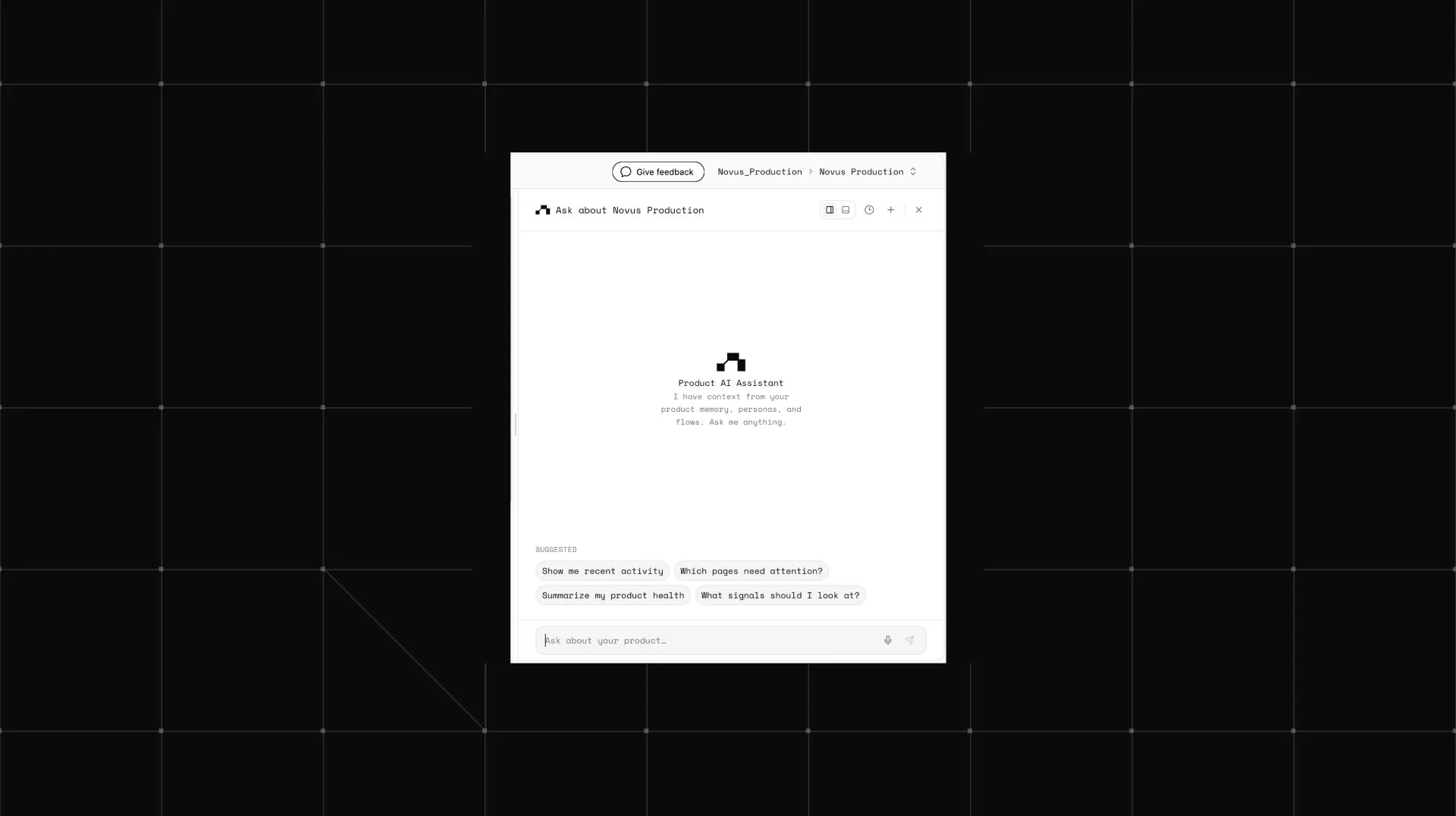
Novus es un agente de producto creado para equipos que desarrollan software al ritmo que el desarrollo de IA hace posible hoy en día. Se conecta al código base, mapea la estructura del producto, instala instrumentación mediante pull request y luego monitorea de forma continua: detecta problemas, señala inconvenientes de UX antes de que lleguen a producción y propone correcciones a nivel de código con aprobación humana antes de que se fusione nada.
El valor práctico está en el ciclo que cierra. A medida que el código cambia más rápido, los flujos de trabajo tradicionales de instrumentación, etiquetado y product analytics se quedan atrás. Una función se lanza, los análisis aún no están configurados para ella, y estás operando a ciegas durante semanas. Novus estrecha esa brecha al mantener la inteligencia de producto actualizada junto con el producto en sí.
Novus está disponible ahora, de forma gratuita. Para los equipos que lanzan rápido y necesitan que el contexto del producto los acompañe, vale la pena evaluarlo desde temprano.
Equipo ideal: PMs técnicos, ingenieros de producto y equipos de producto ágiles.
Advertencia: No es un asistente de escritura ni un copiloto de IA de propósito general. Su valor está en la instrumentación de productos, el monitoreo y la inteligencia.
2. Asistente de IA de propósito general — ChatGPT Enterprise y Claude
Ideal para: Redacción, síntesis, documentación de estrategia, comunicación con partes interesadas Flujo de trabajo de PM: Descubrimiento, planificación, documentación, comunicación
ChatGPT Enterprise y Claude son dos de los asistentes de IA de propósito general más destacados que los PMs utilizan día a día. Ambos son sólidos para redactar PRDs, convertir investigaciones desordenadas en resúmenes estructurados, preparar actualizaciones para las partes interesadas, poner a prueba la estrategia de producto y trabajar en voz alta con problemas ambiguos. Claude suele preferirse para documentos más extensos y un razonamiento más cuidadoso ante compensaciones ambiguas; ChatGPT Enterprise cuenta con el ecosistema de plugins y conectores más amplio.
El techo con cualquiera de los dos depende del contexto. Un asistente general solo es tan útil como lo que le proporcionas. Los PMs que lo conectan al conocimiento de la empresa —Notion, Confluence, Slack— obtienen resultados notablemente mejores. Los PMs que lo tratan como un asistente en blanco obtienen resultados genéricos.
Equipo ideal: Cualquier flujo de trabajo de PM, especialmente roles con mucha documentación o equipos sin una función de investigación dedicada. Advertencia: Ninguna herramienta conoce tu producto, tus usuarios ni tu hoja de ruta a menos que aportes ese contexto. Las decisiones específicas del producto aún requieren datos específicos del producto.
3. Estrategia de producto y síntesis de comentarios — Productboard (Spark)
Ideal para: Síntesis de comentarios de clientes, resúmenes de producto, estrategia de producto, análisis competitivo Flujo de trabajo del PM: Descubrimiento, priorización, planificación de hoja de ruta
Spark es el agente de IA especializado de Productboard, diseñado específicamente para flujos de trabajo de gestión de productos en lugar de adaptarse desde una plataforma de IA de propósito general. Sintetiza los comentarios de los clientes, genera resúmenes de productos, realiza análisis competitivos y trabaja con el contexto de estrategia de producto que los equipos ya mantienen dentro de Productboard.
La ventaja acumulada es la profundidad a lo largo del tiempo. Cuanto más trabajo de producto viva en Productboard, más contexto tendrá Spark para trabajar.
Equipo ideal: Equipos que ya utilizan Productboard como su sistema de gestión de producto, o equipos que evalúan una plataforma centralizada de PM. Advertencia: El valor escala con la adopción. Los equipos que usan Productboard de forma limitada obtendrán resultados más limitados de Spark.
4. Codificación e instrumentación asistidas por IA — Cursor
Ideal para: Flujos de trabajo de especificación a código, tareas técnicas de PM, prototipado ligero
Flujo de trabajo del PM: Construir, validar, lanzar
Cursor es un editor de código impulsado por IA diseñado para el desarrollo de software rápido y asistido por IA. No es una herramienta de gestión de productos en el sentido tradicional, pero los PMs técnicos, los híbridos PM/ingeniero y los equipos de producto que crean prototipos de sus propias funciones lo utilizan cada vez más para convertir una especificación en código funcional más rápido, validar la viabilidad técnica antes de comprometer tiempo de ingeniería, o crear herramientas internas y pruebas de concepto rápidas.
Para los PMs que escriben código como parte de su rol, o que quieren validar una idea de forma práctica antes de involucrar recursos de ingeniería, Cursor cierra la brecha entre "tengo una especificación" y "tengo algo que probar."
Equipo más adecuado: PMs técnicos, ingenieros de producto y equipos que crean prototipos de funciones por su cuenta antes de comprometerse con una construcción completa.
Advertencia: Esta es una herramienta para desarrolladores, no una plataforma para PMs. La mayoría de los product managers no la necesitarán directamente, y no reemplaza la estrategia de producto, la hoja de ruta ni las herramientas de investigación de clientes. Sin embargo, a medida que los roles de product managers e ingenieros se van difuminando (convirtiéndose en Ingenieros de Producto), esto se está utilizando cada vez más en los flujos de trabajo diarios de los PMs.
5. Descubrimiento a entrega nativo de Atlassian — Jira Product Discovery + Rovo
Ideal para: Priorización, captura de evidencia, alineación entre descubrimiento y entrega
Flujo de trabajo del PM: Descubrimiento, priorización, entrega al equipo de desarrollo
Si tu equipo ya trabaja con Jira y Confluence, Rovo hace que la inversión en Atlassian sea considerablemente más útil. Rovo incorpora IA en Jira Product Discovery, generando y transformando contenido, resumiendo el contexto y conectando el trabajo de descubrimiento con los flujos de trabajo de entrega.
La ventaja clave es la continuidad. El trabajo de descubrimiento permanece conectado a los tickets de Jira, el contexto de ingeniería y la documentación de Confluence, sin que los PMs tengan que cerrar la brecha manualmente.
Equipo ideal: Equipos de producto profundamente integrados en el ecosistema de Atlassian.
Advertencia: El valor está vinculado a la adopción de Atlassian. Los equipos que utilizan stacks híbridos o que no son de Atlassian obtendrán menos beneficios.
6. Análisis de datos ad hoc y razonamiento — Claude
Ideal para: Análisis exploratorio de datos, razonamiento sobre preguntas de producto ambiguas, trabajo con datos exportados Flujo de trabajo del PM: Medir, analizar, razonar
Claude y asistentes de IA de propósito general similares son utilizados cada vez más por los PMs para analizar exportaciones de datos, razonar sobre preguntas de producto ambiguas y explorar lo que un conjunto de datos podría estar indicando antes de recurrir a una herramienta de análisis dedicada. Un PM puede pegar un CSV de datos de uso, una exportación de embudo o resultados de encuestas y pedirle a Claude que encuentre patrones, resumir tendencias o señalar anomalías que vale la pena investigar más a fondo.
Esto es fundamentalmente diferente de una plataforma de análisis de productos. Claude no tiene conexión en vivo con tu producto, no realiza seguimiento de eventos ni instrumentación de comportamiento. Solo puede razonar sobre los datos que le proporciones, lo que significa que los datos deben existir y exportarse antes de que Claude pueda ayudar.
Equipo ideal: PMs que realizan análisis puntuales sobre datos ya exportados, o que desean un compañero de razonamiento para interpretar resultados antes de presentarlos. Advertencia: Esto no es un sustituto de una plataforma dedicada de análisis de producto. Los equipos que necesitan seguimiento conductual continuo, análisis de cohortes y paneles conectados a un producto en vivo deben evaluar Pendo Analytics, que combina análisis de comportamiento con orientación en la aplicación, repetición de sesión, y comentarios de usuarios en una sola plataforma.
7. Asistente de IA conversacional — Gemini
Ideal para: Redacción, síntesis de investigación, flujos de trabajo nativos de Google Workspace Flujo de trabajo de PM: Descubrimiento, planificación, documentación
La fortaleza de Gemini para los PMs es su integración nativa con Google Workspace. Los PMs que trabajan en Google Docs, Sheets y Slides pueden usar Gemini directamente dentro de esas herramientas para redactar documentos, resumir hilos largos y extraer estructura de notas desorganizadas sin cambiar de contexto.
Al igual que otros asistentes de propósito general, el valor específico de Gemini para cada producto está limitado por el contexto que el PM le aporta. Destaca en la síntesis y la redacción, pero menos en todo lo que requiere datos en tiempo real sobre el producto o los clientes.
Equipo ideal: PMs cuyos equipos están profundamente integrados en Google Workspace.
Advertencia: La misma limitación que cualquier asistente de IA general: sin conexión nativa a datos de uso del producto, comentarios de clientes o contexto de hoja de ruta, a menos que se proporcionen manualmente.
8. Captura de reuniones y síntesis de investigación — Granola
Ideal para: Llamadas de descubrimiento de clientes, planificación de sprints, revisiones de diseño
Flujo de trabajo del PM: Descubrimiento, investigación, alineación interna
Granola es un bloc de notas con IA que se ejecuta en segundo plano durante las reuniones, capturando el audio del dispositivo sin unirse como un bot visible, y luego enriquece las notas propias del PM con contexto relevante de la transcripción. Para los PMs que realizan llamadas de descubrimiento con clientes, planificación de sprints o revisiones de diseño, resuelve la tensión entre facilitar una conversación y documentándolo con precisión.
El resultado es específico para cada reunión: notas estructuradas, elementos de acción y citas vinculadas a una sola conversación. Los PMs también pueden consultar carpetas de reuniones anteriores para identificar patrones, aunque esto funciona a nivel de "qué discutimos" en lugar del análisis temático estructurado y codificable que ofrece una plataforma de investigación dedicada.
Equipo ideal: PMs que realizan llamadas frecuentes con clientes, sesiones de planificación de sprints o revisiones de diseño y quieren mejor documentación sin sacrificar su presencia en la conversación. Precaución: Granola documenta conversaciones. No reemplaza un repositorio de retroalimentación estructurado ni un análisis de investigación basado en temas. Los equipos que necesitan centralizar el feedback de muchas fuentes y detectar tendencias a lo largo del tiempo también deben evaluar una plataforma dedicada de feedback e investigación, como Pendo Listen.
9. Colaboración de diseño asistida por IA — Figma
Ideal para: Prototipado, colaboración visual, exploración de diseño
Flujo de trabajo del PM: Descubrimiento, validación, colaboración en diseño
Las funciones de IA de Figma son relevantes para los PMs que trabajan estrechamente con diseño en las etapas tempranas del proceso de producto: conceptos, prototipos, diagramas de flujo y validación inicial. Los recursos de Figma orientados a PMs destacan el uso de la IA para agilizar la hoja de ruta, los artefactos de investigación de usuarios, los PRDs, las historias de usuario, los resúmenes del backlog y la colaboración en diseño.
Para los PMs que ya trabajan en Figma durante el descubrimiento, la capa de IA reduce significativamente el tiempo desde la idea hasta algo visual.
Equipo ideal: PMs con estrecha colaboración con diseño, equipos de producto en etapas tempranas de descubrimiento, o roles que abarcan PM y diseño de producto.
Advertencia: Las funciones de IA de Figma aceleran la colaboración y la visualización, pero no son una fuente de verdad del producto. Los insights aún deben validarse con el comportamiento del usuario y conectarse a un flujo de trabajo de entrega.
10. Facilitación de talleres asistida por IA — Miro
Ideal para: Talleres, lluvia de ideas, mapeo de recorridos, alineación interfuncional Flujo de trabajo del PM: Descubrimiento, alineación, planificación
Las funciones de IA de Miro añaden inteligencia a un lienzo colaborativo ya ampliamente utilizado. Es útil para realizar sesiones de descubrimiento, mapear recorridos del cliente, generar hojas de ruta de productos a partir de debates, priorizar elementos del backlog y llevar a cabo retrospectivas.
Los materiales de capacitación para gerentes de producto de Miro destacan los roadmaps generados por IA, la priorización del backlog y las retrospectivas como casos de uso principales, lo que se corresponde estrechamente con lo que los PMs realmente usan Miro.
Equipo ideal: Equipos de producto que realizan talleres regulares, sesiones de planificación interfuncional o sprints de descubrimiento.
Advertencia: Miro es sólido para la alineación y la planificación, pero los resultados deben conectarse a los sistemas de registro — Jira, Productboard o donde sea que viva el trabajo de entrega — para la ejecución y la medición.
| PM need | Recommended capability | Platforms to consider |
|---|---|---|
| PM needKeep product intelligence current as code changes | Recommended capabilityProduct agent | Platforms to considerNovus |
| PM needDraft PRDs, summarize research, create stakeholder updates | Recommended capabilityGeneral AI assistant | Platforms to considerChatGPT Enterprise |
| PM needSynthesize customer feedback into roadmap decisions | Recommended capabilityProduct strategy AI | Platforms to considerProductboard (Spark) |
| PM needPrototype or validate technical feasibility quickly | Recommended capabilityCoding AI | Platforms to considerCursor |
| PM needPrioritize ideas and align with delivery | Recommended capabilityDiscovery/delivery AI | Platforms to considerJira Product Discovery + Rovo |
| PM needReason through usage data or exported reports | Recommended capabilityGeneral AI assistant | Platforms to considerClaude, Pendo Analytics for live behavioral data |
| PM needCapture and structure customer calls or sprint planning | Recommended capabilityMeeting AI | Platforms to considerGranola, Pendo Listen for centralized feedback |
| PM needPrototype and validate ideas visually | Recommended capabilityDesign AI | Platforms to considerFigma |
| PM needRun workshops and planning sessions | Recommended capabilityCollaborative AI canvas | Platforms to considerMiro |
Dónde encajan los agentes de producto en el stack de PM de 2026
La mayoría de las capacidades de IA ayudan a los PMs a trabajar más rápido dentro de los flujos de trabajo existentes. Los agentes de producto hacen algo diferente.
Un agente de producto comprende el contexto del producto: el código base, la estructura de funcionalidades, el comportamiento de los usuarios y los lanzamientos anteriores. Monitorea lo que está cambiando, conecta esos cambios con el rendimiento del producto y recomienda o toma acciones con supervisión humana en el proceso. No es un asistente de uso único. Es una capa siempre activa que mantiene la inteligencia del producto actualizada junto con el producto en sí.
Esto importa porque el ritmo de desarrollo ha cambiado. Con las herramientas de codificación con IA y los flujos de trabajo de desarrollo agéntico que ahora aceleran la velocidad con la que se lanza el software, el enfoque tradicional de revisiones periódicas de analíticas, etiquetado manual y auditorías trimestrales de instrumentación no puede seguir el ritmo. Una funcionalidad que se lanza esta semana puede quedar sin rastrear durante un mes antes de que alguien note la brecha.
Novus es la respuesta de Pendo a ese cambio. Se conecta al código base, comprende la estructura del producto y el comportamiento de los usuarios, instala la instrumentación mediante PR, monitorea los cambios y detecta problemas antes de que se conviertan en tickets de soporte, con aprobación humana antes de que se fusione cualquier cosa. Para los equipos que usan Agent Analytics para entender cómo los usuarios interactúan con las funcionalidades de IA, o que dependen del servidor MCP de Pendo para conectar el contexto del producto con los flujos de trabajo de IA, Novus es la capa de inteligencia continua que mantiene todo actualizado.
Errores comunes al elegir capacidades de IA para product managers
Confundir un conjunto de funcionalidades con un producto independiente
No todo nombre de «IA» en el marketing de un proveedor es un producto separado. Muchas capacidades de IA son funcionalidades integradas en una plataforma que ya usas o que evalúas en su conjunto. Evalúa la plataforma subyacente, no la etiqueta de funcionalidad de IA.
Elegir una herramienta genérica cuando el flujo de trabajo necesita contexto del producto
Un asistente general puede redactar, pero no conoce a tus usuarios, tu hoja de ruta, el uso de funcionalidades ni el historial de lanzamientos. Para tareas que requieren contexto del producto —interpretación de analíticas, priorización, monitoreo post-lanzamiento— las herramientas específicas del producto superan a las generales.
Priorizar las demos sobre la adecuación operativa
Una plataforma puede lucir impresionante en una demo pero rendir por debajo de las expectativas en la práctica si no se integra con Jira, Slack, GitHub, analíticas de producto o tu pipeline de retroalimentación de clientes. Evalúa la adecuación con tu stack real, no con un entorno de prueba.
Ignorar la gobernanza de datos
Los flujos de trabajo de PM involucran datos de clientes, datos del producto, contexto empresarial y estrategia de hoja de ruta. Antes de incorporar cualquier capacidad de IA al flujo de trabajo de un equipo de producto, evalúa los controles de administración, los permisos, las políticas de entrenamiento del modelo y cómo funciona la revisión humana.
Esperar que la IA reemplace el juicio del producto
La IA puede resumir, agrupar, recomendar y automatizar. Los PMs siguen siendo dueños de las decisiones estratégicas: qué construir, qué no construir y por qué. La IA hace que ese juicio sea más rápido y mejor fundamentado. No lo reemplaza.
Olvidar medir el impacto
La capacidad de IA adecuada debería reducir el tiempo en trabajo manual, mejorar las decisiones de producto o acortar el camino desde la señal hasta la acción. Define cómo se ve el éxito antes de adoptarla, para que puedas evaluarla honestamente a los 90 días.