Pendo vs. WalkMe: How do they compare?
WalkMe guides users through apps. Pendo transforms how users interact with them.
Choosing between Pendo and WalkMe means deciding between two fundamentally different approaches to digital adoption. WalkMe pioneered the Digital Adoption Platform (DAP) category—helping enterprises guide users through complex workflows with overlays and walkthroughs. Pendo evolved the category, with a unified platform that doesn't just guide users, but understands why they struggle and optimizes experiences continuously.
Put Pendo to the test

One unified platform from the start
Unlike WalkMe’s disjointed tools and complex integrations, Pendo's unified, intuitive platform combines analytics, segmentation, and in-app guidance in a single cohesive solution. What does this mean for Pendo customers? Faster implementation, less complexity, and measurable impact all in a single tool.
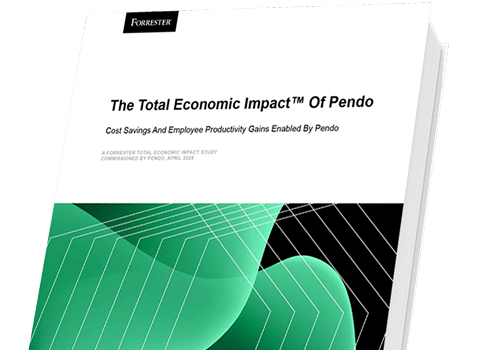
The Total Economic Impact of Pendo
How has Pendo evolved the DAP category?
Digital adoption platforms (DAPs) like WalkMe emerged over a decade ago to help enterprises guide employees through complex software changes during cloud migrations. They focus on process efficiency—helping users complete tasks with walkthroughs, tooltips, and step-by-step overlays.
The Pendo platform represents the evolution of this category. Rather than just guiding users through workflows, it combines deep behavioral analytics, targeted in-app guidance, and continuous feedback loops to understand why users struggle, where experiences break down, and how to optimize software effectiveness. The shift is from "help me use software" to "help me understand and improve how work gets done."
Today's enterprises don't just need adoption guidance—they need visibility into cross-application workflows, predictive insights on user behavior, and the ability to measure whether their software investments are delivering business outcomes. That's the difference between WalkMe and Pendo.
WHY COMPANIES CHOOSE PENDO OVER WALKME
01 Uncover root issues, not surface-level symptoms
WalkMe provides reactive, overlay guidance to influence user behavior to solve known issues in the software stack. But WalkMe lacks deep, cross-application analytics to uncover broader, underlying issues in employee workflows and usage patterns.
Pendo’s combination of robust analytics (Portfolio View, Paths, and Workflows), feedback capabilities, and Session Replay provide deep visibility into exactly where users encounter friction, enabling targeted improvements rather than superficial fixes.
Companies leveraging Pendo achieve lasting changes in user behavior, significantly reducing workflow friction and enhancing overall productivity.


“We’re all about paying attention to the details. We always want to pick the right things to work on. Pendo helps us do this.”
Becky Banasik, VP of Customer Success at Cision
02 Faster deployment, faster value
WalkMe implementations are complex, service-heavy, and typically take over six months to complete, delaying business impact and driving higher ownership costs.
Pendo’s easy, no-code, AI-based tagging deployment means you can implement quickly. Get actionable insights and tangible improvements with minimal overhead.
Organizations adopting Pendo experience accelerated return on investment, reduced operational costs, and faster time-to-value.


“Pendo has created an efficient scenario whereby we can set these trials up quickly. Since launch, we’ve saved an hour of effort for each trial and were able to redeploy those saved hours to a consultant team focused on more strategic tasks.”
Alex Reilly, Senior Customer Success Manager at Infor
03 Real AI-driven insights, not just suggestions
WalkMe’s generative AI (WalkMe X) offers contextual suggestions, but lacks predictive analytics or machine learning, limiting its capability to proactively address user behavior issues.
Pendo’s purpose-built AI leverages predictive analytics and machine learning, grounded in validated quantitative and qualitative data, providing deeper insights and proactive recommendations.
Companies using Pendo leverage predictive insights to proactively address issues, optimize workflows, and significantly enhance user adoption and productivity.


"To us, Pendo’ing means solving user pain points around guidance tracking, experimentation, or awareness. We also build analytics into every single user story that we write—so there’s always a component of tracking metrics we build in through Pendo.”
Vinay Shukla, Product Manager at Thomson Reuters
04 Future-proof innovation, built for scale
With its recent acquisition by SAP, WalkMe risks slowed innovation and prioritization challenges, focusing on merging technologies rather than driving new value for users.
Pendo remains independently driven and continually innovating at scale. From day one, Pendo has been specifically designed to support complex enterprises without cumbersome integrations or slowed development cycles.
Enterprise customers using Pendo achieve ongoing innovation, consistent operations, and enhanced scalability (without sacrificing agility).

"People can see that we are continually innovating and listening to feedback and building new stuff every week and every month. Pendo is one of the tools that really enables us to do that.”
Josh Todd, Principal Product Manager at TUNE
Pendo vs. WalkMe:
Key Capabilities Comparison
What your business needs


User analytics
Deep, cross-application analytics (Portfolio View, Paths, Workflows)
Limited cross-app analytics, no retroactive data
Deployment speed
Rapid, no-code implementation
Complex, service-intensive, lengthy implementation
AI capabilities
Predictive and proactive analytics
Generative, contextual suggestions only
Platform integration
Single unified platform
Multiple disjointed tools and interfaces
Innovation and agility
Independent innovation at scale
Slowed innovation post-SAP merger
Evaluating WalkMe and Pendo alternatives for digital adoption
Whether you're researching WalkMe alternatives, evaluating Pendo competitors for specific use cases, or exploring digital adoption platforms for the first time, the right choice depends on your organization's priorities. WalkMe excels in complex enterprise workflows and established software ecosystems. Pendo leads for organizations needing unified analytics across customer and employee experiences with faster time-to-value. Other alternatives like Userlane, Whatfix, and Fullstory serve specific use cases—but may lack the depth of analytics and breadth of capabilities offered in a comprehensive platform.
This comparison focuses on WalkMe vs. Pendo because these platforms represent the two leading approaches in the market: traditional digital adoption versus modern software experience management. For enterprises choosing their primary digital adoption solution, understanding these approaches is often the decisive factor.
Why companies switch from WalkMe to Pendo
With Pendo, we no longer request data from the [business intelligence] engineers and other resources. We are completely done. That has gone from a regular occurrence to zero.”
UX Director, Technology
Join THE PENDO Community
More than just a vendor
Collaborate with other Pendo experts in person and virtually, connect with your peers in a dedicated Slack workspace, and amplify your impact with Pendo.

PendomoniumX
Unforgettable one-day events where you’ll get inspired by top thinkers across software, connect with your peers, and learn how to lead your company in the age of AI.

Mind the Product
Learn from product experts and become part of the world’s most engaged community for product managers
->

Pendo User Groups
Meet in person or virtually to connect with peers, exchange best practices, and learn Pendo tips and tricks.

Pendo Academy
Explore on-demand courses and hands-on training to deepen your knowledge and maximize value.
Frequently asked questions
WalkMe is primarily built for digital adoption in employee-facing applications, such as Salesforce or Workday. It lacks robust product analytics and discovery capabilities for customer-facing apps, which Pendo provides comprehensively.
WalkMe implementation often takes six months or longer. Pendo, by comparison, typically has customers up and running in under six weeks.
No, WalkMe only stores analytics data for one year, compared to Pendo’s seven-year data retention.
Since being acquired by SAP, WalkMe's innovation has slowed due to integration efforts. Pendo remains focused on continuous innovation and dedicated customer-facing product experiences.
Since being acquired by SAP, WalkMe's innovation has slowed due to integration efforts. Pendo remains focused on continuous innovation and dedicated customer-facing product experiences.WalkMe is a Digital Adoption Platform focused on guiding users through internal enterprise software workflows. Pendo is a Software Experience Management platform that combines product analytics, in-app guidance, and user feedback in a unified platform for both customer-facing and employee applications—giving teams a single source of truth for understanding and optimizing software experiences.
Both platforms offer in-app guidance, but they approach it differently. WalkMe provides reactive overlays to guide users through known workflows. Pendo combines predictive analytics with guidance—identifying where users struggle before creating targeted interventions, measuring guide effectiveness, and continuously optimizing based on behavioral data.
Pendo customers report 396% ROI with a 6-month payback period and $1.2M in team efficiencies. Key drivers include faster implementation, reduced support tickets, improved feature adoption, and analytics-driven product decisions.
WalkMe is a powerful platform, but its high degree of complexity often leads to long implementation cycles, delayed time to value, and reliance on specialized or third-party resources to deploy and maintain. Pendo's no-code platform enables product managers and customer success teams to create guides, analyze behavior, and collect feedback without developer dependencies—reducing total cost of ownership and accelerating iteration.
Pendo AI is trained on 35 trillion behavioral events, offering predictive churn analytics (Pendo Predict), AI-generated retention insights, automated qualitative feedback summaries, and agent analytics for AI assistants. WalkMe focuses on generative recommendations and overlays that assist with guided workflows, but lacks the depth of predictive, machine-learning-driven analytics needed to anticipate churn, understand journeys, or drive strategic product decisions.
WalkMe offers separate products for employee vs customer use cases. Pendo provides a unified platform supporting both from a single implementation—with shared analytics, consistent experiences, and reduced complexity. This eliminates duplicate tools and enables cross-functional insights across customer and employee software experiences.
We live for product conversations.
Adoption strategies, AI rollouts, proving ROI: Our team gets genuinely excited about solving these challenges with you.